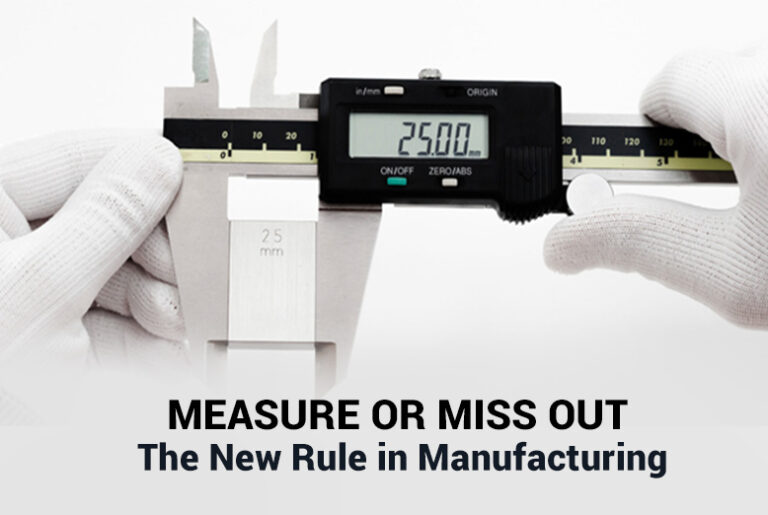
We cannot deny that the global landscape is now very competitive and unpredictable. The manufacturing world now values precision more than ever. It is not just a value-added amenity, but a valuable asset. Manufacturing now lives with a new rule, to measure not as an occasional checkpoint but to measure in every single step of the process or else miss out. Nowadays, one small defect can have a major impact, and result to millions in losses. An overdue delivery can sever and affect a relationship with a client. A simple miscalculation can be detrimental from inventory levels to customer satisfaction. Measuring everything is today’s most valuable rule.
Based on history, manufacturing decision were almost always guided by intuition and experience. It was all about gut feeling. Even the most seasoned operator simply felt that there was something wrong with the machine. A line manager depended on mere visual checks then approved products. Component inspection was not that meticulous. It was all about instinct.
While they were helpful (gut feeling and instinct) and continue to be helpful today, the complexity of today’s manufacturing cannot rely only on instinct. There is already a need for real-time measurement systems to result to proactive operations. Data-driven operations are prioritized to ensure quality products. Tech devices are employed like IoT devices, sensors, and other necessary tech to check temperature, torque, vibration, and viscosity. Companies with these kinds of measurement systems have a competitive advantage to others, especially that with margins tighter than ever and expectations higher than ever, precision has become non-negotiable.
Precision is Key
Precision is the key to success in all sectors that involve manufacturing, even in automated production lines and in the sectors of pharmaceuticals, electronics, automotive, and healthcare. Even the most minimal aberration can be disastrous. Precision is not just a bonus feature or for the sake of product quality. Precision is a need if you want to survive in the world of business. Without it, you are doomed.
Precision is crucial especially in attaining accurate and consistent products. This will also lead to high-quality products, cost-efficiency, and reduced waste. It helps manufacturers achieve the stringent standards of the industry, produce parts that are complex, and acclimate with the evolving technological advancements.
A. Improve Performance and Product Quality:
· Reliable, Repeatable Results
Precision allows every component to be manufactured to accurate specifications thereby enhancing the product quality overall. Princeps is an example of ensuring products are reliable through component inspection services.
· Engineered for Reliability. Built to Last.
Through precision, component are built to perfectly fit together, hence minimizing fast degradation and making the product last for longer.
· Engineered to Meet and Exceed Rigorous Specifications
Precision allows components to be engineered to meet and exceed strict quality requirements for several industries.
· Production of Complex Parts
Only through precision manufacturing the can intricate parts with tight tolerances may be manufactured to contribute to advanced technologies and high-performance products.
B. Cost-effectivity and reduction of waste
· Minimized Material Waste
Precision in manufacturing reduces material waste since there will be few or minimal errors and revisions.
· Cheaper Labor Costs
Because the manufacturing process is automated and precise, then it can minimize the need for man power or manual labor.
· Faster Manufacturing Process
More will be produced in lesser time because of the advanced machinery and automation.
C. Flexibility and Creativity
· Adaptable and Innovative
Precision manufacturing can open the door for working with more variations of materials.
· Integration of Industry 4.0
Through precision machining, companies can cope up with the Fourth Industrial Revolution, the ongoing transformation of manufacturing and industrial process through combination of digital technologies.
· Design Innovation
Through precision, more complex products can be manufactured.
· Minimal Human Error
Precision in manufacturing reduces human error risks, hence, making production processes safer and ensuring no or fewer accidents.
· Critical Applications
Precision ensures the products will also be safe to use by its users.
· Easier to Track
Precision machining improves traceability.
From Measurement to Insight
The importance of patience and precision is not just about gathering and collating data, but interpreting data not just to comprehend what has occurred but also to prepare for what could possibly happen.
1. Material waste
2. Return of Products
3. Regulatory Fines
4. Compromised Brand Integrity
5. Overdue shipments and cancelled contracts
Unfortunately, even a minimal lapse can lead to lawsuits or injuries or life-threatening failures. This gives heavy weight on precision. Because right now, measuring everything is the new minimum.