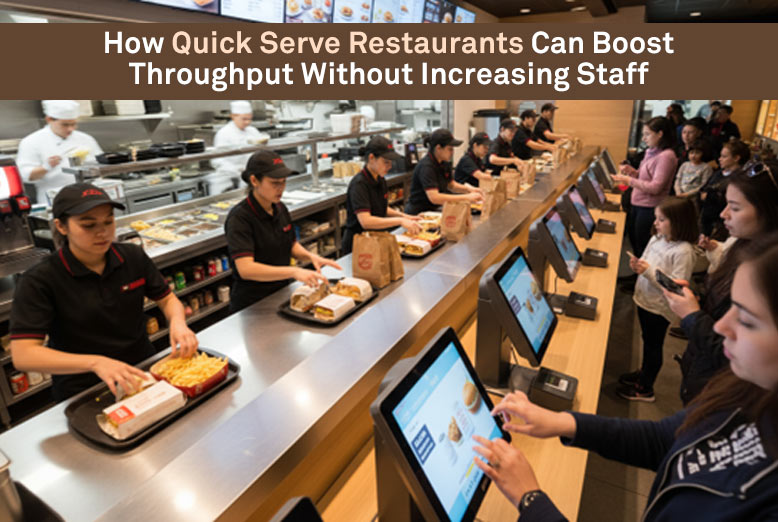
In quick serve restaurants (QSRs), speed doesn’t translate just to convenience – it directly impacts your bottom line. Each second a customer waits is an order lost or a missed upsell. Your operators are squeezed from all sides, including rising costs, shrinking labor pools, and higher customer expectations. The solution isn’t in hiring more staff; it’s translating into a smarter system. By optimizing QSR throughput with quick serve restaurant POS and advanced restaurant back-of-house software, QSRs can serve more customers, reduce errors, and boost their bottom line.
A recent 2025 study of QSRs found 68% of operators now deploy handheld POS devices for line‑busting, out of which 63% reported higher average check size, and 70% saw improved guest satisfaction.
But when it comes to QSR throughput, the question is:
What “Throughput” Means in a Quick Serve Restaurant?
QSR throughput is the measure of welcoming customers, efficiently delivering orders, and letting them leave satisfied. Terminals in QSRs that affect throughput include drive-thrus where customers order, the kitchen where food is prepared, and handoffs where orders are delivered. To measure QSR throughput, your operators must measure orders per minute, time for preparation, and how accurately the order is delivered to the customer.
The Hidden Bottlenecks That Slow Down QSR Operations
QSRs face multiple challenges during peak hours. Excessive Kitchen Order Tickets (KOTs) overwhelm food preparation.
A few bottlenecks usually encountered in QSRs during peak hours are:
- Slow order-taking processes
One of the core reasons for slowing down QSR operations is understaffing or inadequate staff training. When the staff is limited, it leads to a slowdown in order taking.
- Menu complexity and manual entry errors
When the menu is complex and orders are taken manually (e.g., at a drive-thru speaker), it directly impacts speed.
- Limited kitchen visibility
When staff can’t see what’s in the queue, which station is overloaded, or which items are falling behind, the kitchen quickly becomes unbalanced.
- Inconsistent handoff workflow
Common bottlenecks while handling handoffs include:
- Staff searching bags, sauces, labels, or condiments.
- Multiple staff members handling the same order.
- Siloed systems between POS ↔ kitchen, ↔ inventory
When the POS, kitchen, and inventory work in siloes, there is miscommunication and duplication of efforts.
Technology That Helps QSRs Increase Throughput Without Adding Staff
The right QSR technology removes bottlenecks, reduces manual steps, and keeps orders flowing seamlessly. These technologies include:
AI-Powered Ordering
AI-powered ordering fosters an environment of:
- Faster order-taking
Systems tailored for drive-thrus use speech recognition and conversational AI to take orders.
- Automated upsells
As AI-ordering assistants upsell seamlessly, it gives a consistent experience and maximizes check size.
- Reduced manual error
AI takes the order automatically, leaving minimal space for manual error.
Smart Kitchen Display Systems
Smart KDS is the backbone of a high-throughput QSR. It helps QSRs via:
- Automated ticket routing
Once the order is taken, it is pushed to the KDS, removing the scope of miscommunication.
- Prep-time prediction
Looking at preparation time in hindsight, KDS suggests the time taken to prepare the food item.
- Real-time kitchen visibility
When an order is placed, KDS displays the stage of food prep.
Self-Service Kiosks
- Reduce front-counter load
With self-checkout kiosks, the need for a staff member at the counter is eliminated. This implies staff can work on food prep and delivery instead of taking orders.
Integrated Inventory & Menu Management
- Faster menu updates across channels
Once the menu is updated across an outlet, it can simply be scaled at all the joints.
- No delays due to out-of-stock items
When an inventory runs out of stock, the KDS automatically informs it beforehand.
The Impact: Real Numbers QSRs Achieved
Some powerful stats of QSR are:
- Reduced order-taking time
According to research, QSRs using AI ordering take 3 minutes 53 seconds compared with around 4 minutes 15 seconds for non-AI locations.
- Better accuracy → fewer remakes
- AI-based ordering systems achieve 95–98% order accuracy, versus 85–90% for human order-takers during peak periods.
- AI voice-ordering reduces typical drive-thru ordering errors, historically as high as 17% under human staff.
- Higher peak-hour throughput
According to a recent 2025 review by QSR Magazine, restaurants using AI-powered ordering had an average total service time of about 314.6 seconds compared with 335.4 seconds for non-AI locations.
How NOVA Helps Quick Serve Restaurants Scale Throughput?
- AI-native POS designed for high volume
NOVA is an AI-native POS designed specifically for high-volume QSRs where speed, accuracy, and throughput directly impact revenue. It actively automates order-taking, eliminates bottlenecks, and adapts to peak-hour demand.
- Real-time kitchen coordination
NOVA directly interacts with KDS. You can have a direct insight into the food preparation status. This ensures every station in the back-of-house operates in complete sync, even during peak hours.
- Automated upselling
NOVA checks customers’ buying history and upsells their favorite item. This way, it can increase Average Order Value (AOV) and offer a tailored experience to each customer.
- All-in-one ordering + inventory + menu + reporting
NOVA syncs POS, KDS, inventory, menu, and reporting – all built in one module. You can promote items on the menu based on expiring food items as the top-selling items, and generate reports to see performance.
- Mobile ordering, kiosk, drive-thru, and QR-ready
NOVA runs seamlessly whether it’s a smartphone scan, high-speed drive-thru lane, branded mobile app, kiosks, or any other channel. Simply scan the QR code, and your customers are good to go.
Quick Wins QSR Owners Can Implement This Week
Here are some proven quick wins you can roll out for your QSR within days:
- Simplify your top 5 selling items
Streamline the menu to focus on the most popular, high-margin, and easy-to-prepare items. By reducing menu complexity, you can help your kitchen move faster, minimize errors, and shorten wait times.
- Use prep-time tracking
By identifying how much time each item takes to prep, QSRs can identify bottlenecks, balance station workloads, and adjust staffing. This ensures the popular items take less time to prep, thus reducing delays.
- Optimize handoff area layout
By ensuring a dedicated, clearly marked area for completed orders and organizing orders ergonomically for easy pickup, you can rescue congestion and speed up delivery.
- Automate low-value staff tasks
Low-value tasks like order entry, receipt printing, beverage dispensing, or routine inventory checks can be handled by AI-native POS systems like NOVA.
Throughput is the QSR Growth Lever
So now that we know what QSR throughput is, we know QSRs do not need more people – they need smarter systems to operate. With the right POS and automation in place, QSRs can serve customers faster, improve order accuracy, and boost AOV, all while maintaining quality during peak hours. By focusing on QSR efficiency and flow rather than headcount, restaurants unlock higher volume, happier customers, and stronger profitability.
Also Read ; Emerging Business Opportunities in the Restaurant Industry in Dubai