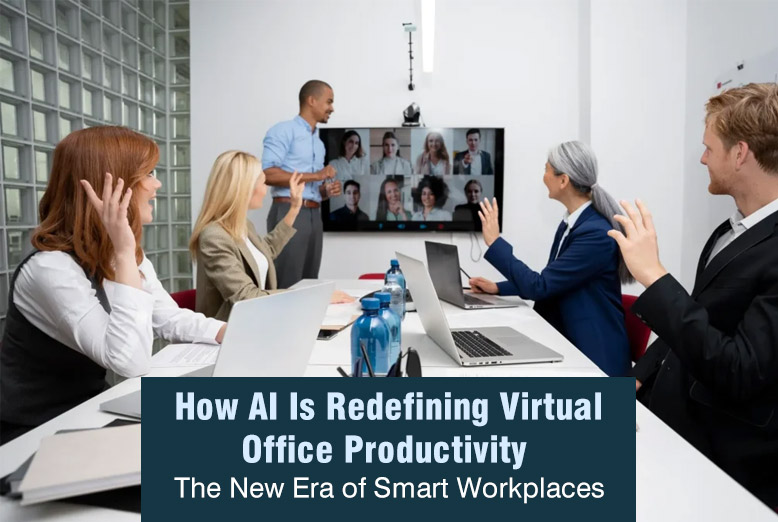
Over the past decade, virtual offices have shifted from a temporary alternative to a core business strategy. Remote work’s evolution—once driven by necessity—has become a deliberate model chosen for flexibility, cost efficiency, and access to a global talent pool. Yet, what’s changing the landscape even more dramatically is the rise of artificial intelligence. AI is transforming virtual office productivity in ways that go far beyond automation. It’s reshaping how teams collaborate, how leaders make decisions, and how organizations scale.
Today, virtual offices are no longer just digital extensions of physical workplaces; they are becoming intelligent systems powered by machine learning, natural language processing, and predictive analytics. As AI streams into every corner of remote work—from workflow optimization to communication, reporting, and security—the digital office is becoming smarter by the minute.
From Passive Tools to Active Work Partners
Before AI entered the scene, virtual work was supported by passive software: video meetings, messaging apps, cloud documents, and project boards. Useful, yes—but reactive. Employees still had to coordinate tasks manually, handle follow-ups, track deadlines, or extract insights from data.
Today’s AI tools are proactive and partner-like. They predict what needs to be done, surface priorities, manage schedules, take meeting notes, summarize conversations, and even recommend strategic decisions.
For example, AI-powered assistants now:
- Generate instant meeting summaries based on speech recognition
- Identify project bottlenecks by analyzing workflow patterns
- Automate repetitive tasks like time tracking or data entry
- Recommend tasks that need priority attention
- Translate conversations in seconds, enabling cross-border teams to work seamlessly
This shift from passive to intelligent tools has been a major turning point for virtual office efficiency. Employees spend less time coordinating work and more time doing it. Managers gain clarity without micromanagement. Teams collaborate without friction.
Smarter Meetings, Less Fatigue
If there is one area where AI has made an immediate difference, it is virtual meetings. Remote workers once complained that digital meetings consumed too much time, drained energy, and created more tasks than they solved.
Now AI platforms are rewriting meeting culture. Tools like automatic agenda creation, real-time transcription, and sentiment analysis reduce the need for lengthy discussions and manual documentation. AI can record key points, track decisions, produce action lists, and send reminders—allowing participants to stay present rather than multitask.
Some organizations have adopted AI-generated meeting replacements. Instead of gathering everyone in a call, employees submit short voice messages or updates. AI compiles them into a coherent briefing and delivers it as text or video. The outcome: meetings that once ran for an hour now take five minutes.
Productivity Tracking Without the Surveillance Problem
Remote workers have long felt tension between accountability and autonomy. Traditional monitoring tools—screenshots, keystroke tracking, webcam checks—were resented and linked to workplace anxiety.
AI introduces a more ethical model. Instead of tracking behavior, it analyzes output. Rather than scrutinizing activity, it measures patterns. Workers are not monitored; workflows are.
For instance, AI can:
- Spot duplicate work
- Identify communication gaps
- Measure output speed
- Predict burnout risks
- Optimize task distribution
- Suggest better deadlines
These insights help leaders make decisions grounded in data, not assumptions. As a result, teams become more efficient without sacrificing trust.
AI Is Ending Digital Overload
Virtual offices have created an avalanche of digital noise—emails, pings, documents, dashboards, notifications, missed calls, and status updates. In many companies, workers spend more time managing information than producing results.
AI tools now filter and simplify digital clutter. They group emails by intent, highlight urgent tasks, silence unnecessary alerts, and surface only what requires action. Some platforms even build personalized work hubs: a single dashboard with everything a specific employee needs to see that day.
The benefit is enormous—less distraction, smoother focus, and faster output.
Virtual Collaboration Is Becoming Borderless
AI translation and transcription are reshaping how global teams operate. Language differences, once a barrier to remote work, are becoming irrelevant. AI tools can translate video calls, chat messages, and documents instantly.
With this shift, virtual offices are evolving into borderless workspaces. Companies no longer need region-based hubs or local teams to operate internationally. Talent can be hired anywhere, and communication flows easily across cultures and time zones.
Decision-Making Is Becoming Data-Driven
One of AI’s most powerful contributions is its ability to turn information into insight. Remote companies produce enormous amounts of data—work logs, messages, documents, customer feedback, meeting transcripts. AI can analyze all of it and identify patterns no human could detect.
Leaders can now answer questions like:
- Which tasks take the most time?
- Where are teams struggling?
- Which processes should be automated?
- What tools create the best results?
This level of clarity drives better decisions, faster growth, and higher performance.
The Human Factor: A Better Experience for Workers
While AI is a technological revolution, its real value is human. Workers in virtual offices often struggle with isolation, overload, and burnout. AI helps relieve pressure by:
- Automating routine work
- Reducing repetitive tasks
- Simplifying communication
- Shortening meetings
- Providing personalized workflows
Employees gain more time for creative thinking, innovation, and strategic problem-solving.
What Comes Next
AI is not replacing remote workers—it is empowering them. The future virtual office will be a place where:
- Workflows adjust automatically
- Tools learn employee habits
- Collaboration happens across time zones
- Leaders manage through insight, not oversight
- Productivity rises without pressure
As companies adopt AI-driven systems, the virtual office will no longer be defined by location, hours, or tools. It will be defined by intelligence, flexibility, and performance.
The organizations that embrace this shift early will run faster, operate smoother, and attract the best talent from anywhere in the world.
AI is not just improving virtual office productivity—it is reinventing it. And we are only at the beginning.
Also Read : 5 great reasons for a business to be based in a virtual office