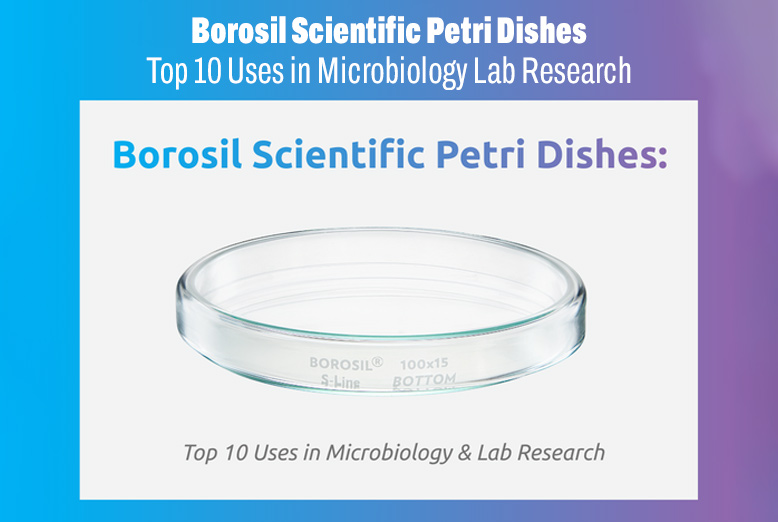
There are very few tools in microbiology that are as universal or as relied upon as the Petri dish. Whether isolating bacterial colonies, culturing fungi, or preparing agar plates for antibiotic assays, precision and repeatability depend on the dish’s geometry, optical quality, and surface uniformity. For laboratories that require consistency through hundreds of sterilisation cycles, borosilicate glass remains the standard.
Within this category, two variants stand out from the Borosil Scientific lineup: the 3160 Petri Dish, a general-purpose culture vessel, and the 3165 S-Line Petri Dish, built for high-throughput work and repeat handling. Both of these products are engineered to maintain dimensional stability and visual clarity through autoclaving, with each design optimised for specific workflows across microbiology, pharmaceutical QC, and plant tissue culture. In this post, let’s talk about the top 10 uses of these two types of petri dishes in lab research and microbiology in detail.
- Microbial Culture and Isolation
For isolating bacteria and counting colonies, the surface must be flat and transparent to the naked eye. The level base of the 3160 Petri Dish allows the agar media to harden evenly, ensuring that the colonies are spread out predictably. Because it is made of borosilicate, it can be heated and sterilised repeatedly, unlike plastics, which can warp or develop a hazy surface.
The 3165 S-Line Petri Dish takes it a step further, incorporating white enamel printing that clearly marks both the lid and base, thereby reducing sorting errors during batch operations. The bubble-free clarity helps during fine observation under stereomicroscopes or image analysis systems.
- Antibiotic Susceptibility and Zone Measurement
For testing antibiotic sensitivity, optical precision is necessary to obtain an accurate reading of the inhibition zones. The surface of the glass must be scratch-free and free from other imperfections that could affect the readings. The S-Line series achieves this with a precise polishing method that creates an optically pure base free from distortion.
The flatness tolerance ensures that the antibiotic discs remain in contact with the agar surface. When calibrated callipers or digital imaging are used together, results can be repeated across multiple assays, which is very important in regulated QC and clinical settings.
- Fungal Growth and Sporulation Studies
It takes longer to grow fungi, and the humidity needs to be higher than for bacterial cultures. Long cycles don’t change the structure of glass Petri dishes, so they don’t leak or deform. Because they are transparent, you can observe the early stages of mycelial growth without needing to open the lid.
In laboratories working with high-spore fungi, borosilicate glass is preferred for its resistance to surface fouling and ease of sterilisation using dry heat at up to 180°C. The 3160 Petri Dish remains the standard choice in mycology sections of research and diagnostic facilities.
- Anaerobic Culturing
For anaerobic systems to function correctly, they must be airtight and maintain a stable shape. Even small changes in shape can compromise chamber seals, allowing oxygen to enter. Polystyrene dishes often warp, but glass dishes retain their shape and lids fit snugly, even when subjected to pressure and condensation.
The S-Line Petri Dish, with precise lid-to-base clearance, ensures uniform atmospheric conditions across stacked chambers. It’s used extensively in pharmaceutical microbiology labs conducting sterility testing under reduced oxygen environments.
- Plant Tissue Culture
Laboratoryculture depends on stable conditions and even media thickness. Uneven surfaces lead to nutrient pooling, which can alter growth. The 3165 S-Line Petri Dish features a perfectly level inner surface, ensuring even media distribution, which is critical in explant and callus culture setups.
Its high transparency facilitates light penetration in illuminated incubators, while the clear enamel markings facilitate easy differentiation between batches during sequential subculturing.
- Environmental Monitoring and Surface Sampling
Pharma manufacturing and cleanroom facilities rely on settle plates and surface contact testing to ensure compliance with ISO 14644 standards. For this, consistency in plate geometry is very important.
Glass petri dishes are sterilised before use and reused multiple times for air sampling or swab-based microbial recovery. The 3160 Petri Dish features a tight-fitting lid that reduces airborne contamination while still allowing for controlled gas exchange. Once sampling is complete, the dish can be reprocessed through standard detergent and acid cleaning cycles without surface deterioration.
- Phage Typing and Bacteriophage Research
For bacteriophage assays, soft agar is placed on top of a base layer that contains bacterial lawns. The overlay needs to spread evenly, and the dish’s surface must remain flat. The S-Line variant’s finely ground inner base ensures that plaque morphology studies always yield the same results.
Unlike disposable options that change shape when heated, borosilicate retains its shape and provides even thermal conductivity, which is beneficial for researchers conducting heat-sensitive phage induction assays.
- Molecular Cloning and Transformation Workflows
During genetic transformation, particularly E. coli-based cloning, Petri dishes serve as the substrate for antibiotic selection. Plates must remain sterile, dimensionally consistent, and chemically inert.
The 3160 Petri Dish features a smooth, hydrophilic surface that facilitates the even spreading of transformation mixes and antibiotics. Additionally, glass dishes promote colony recovery post-incubation, as bacterial clumps adhere less firmly to the surface than on polymer alternatives, thereby reducing mechanical disruption during picking.
- Media Sterility and QC Testing
Pharmaceutical and biotechnology labs often check that batches of ready-made media are sterile before they are used in production. This involves placing control organisms on plates to make sure the nutrients are consistent and there are no contaminants.
Glass petri dishes are ideal because they provide no background interference and are chemically inert, making sure there’s no trace leaching of ions or residues into the media. Their dimensional stability also supports stacking in incubators without tilting, maintaining even airflow and temperature across multiple plates.
- Educational and Demonstration Use
Universities and training centres like to use borosilicate petri dishes for practicals and demonstrations. They can be cleaned multiple times, and the enamel labels on S-Line models help students match the lids and bases correctly, preventing them from getting dirty from mixing them up.
These dishes are durable enough to handle repeated sterilisation and economical for institutions focusing on sustainable lab operations. The clarity allows for the visualisation of colony morphology and pigmentation directly under low-power microscopes, helping with basic microbial differentiation exercises.
Conclusion
Glass petri dishes remain integral to modern microbiology and research. The 3160 and 3165 S-Line series from the Borosil Scientific lineup demonstrate how precision engineering, repeat-use durability, and user-focused design continue to define reliable culture work. Laboratories seeking reproducible results, easy maintenance, and sustainable operations continue to prefer these designs, which are functional, robust, and engineered for accuracy.
Also Read ; The Role of Library Sequencing in Genomic Research