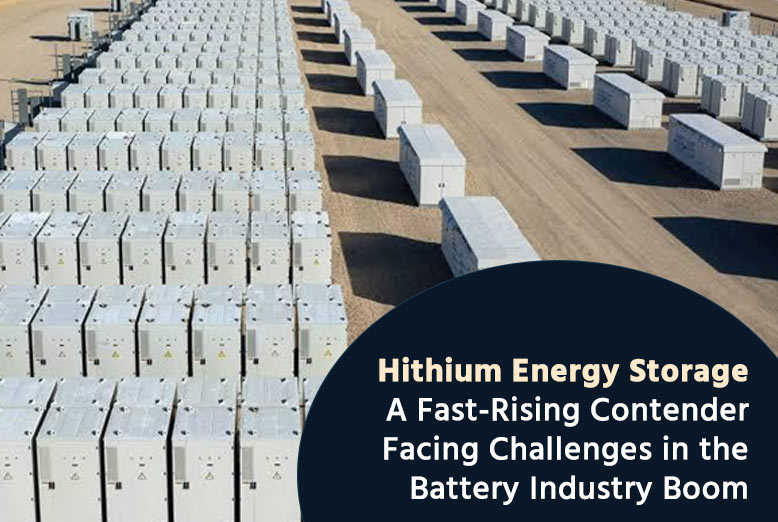
Hithium has become one of the most talked-about stationary battery companies in the industry in the relatively short span of seven years. Founded in 2019 in the city of Xiamen, Fujian Province in the People’s Republic of China, Xiamen Hithium Energy Storage Technology Co., Ltd. has differentiated itself from its competitors with its singular focus on the production of stationary battery energy storage systems (BESS).
While electric vehicle (EV) batteries currently dominate over 70% of total lithium-ion battery deployment globally, steadily increasing demand for the short-term storage of large amounts of energy produced from renewable sources for peak-hour consumption is set to overtake it between 2030 and 2034. Based on market research published in the second half of 2025, Hithium is among the two largest producers of energy storage batteries worldwide.
Hithium’s rapid rise to fame has, however, been accompanied by similarly notable controversies regarding the founding, financial health, and international expansion of the company. Hithium has filed more than 4,000 patents across China, Europe, and the U.S., covering battery chemistry, systems design, and manufacturing technologies. While this presents the image of an innovative business venture, in the world of intellectual property rights, the firm has been off to a rocky start due to a high-profile lawsuit filed by CATL (Contemporary Amperex Technology Co., Ltd.) against its founder and chairman, Wu Zuyu.
In 2025, CATL claimed over 150 million yuan in damages over the violation of non-compete laws, and disputes between the two companies continue into 2026. CATL alleges that Hithium, under the leadership of Mr. Wu, systematically poached employees from CATL and facilitated those employees’ breach of non-compete agreements. Indeed, Mr. Wu, a former CATL employee, has also been accused of violating his own non-compete agreement with CATL when founding Hithium, and a Chinese arbitration tribunal fined Mr. Wu 1 million yuan in 2023.
Supported by approximately 8,000 employees globally and four dedicated research and development (R&D) institutes in service of its innovation efforts, Hithium’s portfolio currently includes lithium-ion and sodium-ion liquid-cooled battery systems in the form of large-capacity battery cells and vertical, containerized energy storage systems, with an emphasis on 4–8-hour duration and stationary, as opposed to mobile, operation.
In 2022, the company pioneered its own technology for long-duration energy storage and launched the first 1000+ Ah battery in the industry. The capacity of Hithium’s products currently ranges between 50 Ah and 1175 Ah. Ongoing legal troubles regarding patents and trade secrets, however, raise questions about the risks Hithium’s products may face if court-ordered injunctions are issued in the future.
Besides endeavors in its native domestic market, Hithium has deployed solutions in more than 20 countries internationally, including in Europe and the United States. In 2026, Hithium formalized its initial agreement for the construction of a manufacturing plant in Pamplona, Spain, with an initial investment of approximately 400 million euros.
In 2025, the company developed its first energy storage project in Hungary as part of a broader entry into Eastern Europe that includes Romania, Bulgaria, and North Macedonia. In 2025, Hithium also opened an assembly plant in Mesquite, Texas, in the United States, a project which later garnered criticism for not meaningfully reducing the company’s exposure to U.S. government tariffs.
Hithium’s international expansion and rapid projected growth led to an application for an initial public offering (IPO) on the Hong Kong Stock Exchange (HKEX) in March 2025, which was rejected by regulators who identified significant issues with the company’s A1 filing, including the omission of important information necessary to reliably inform investors of the company’s value and growth potential.
HKEX attracted a large number of new listings in 2025—many of them technological companies active in key industrial fields—due to its easing of requirements over the past two years. Access to the exchange represents significant financial opportunities for firms looking to attract overseas investment. Criticism levied against HKEX by experts has led regulators to more closely reevaluate prospective companies looking to list on the exchange, Hithium being no exception.
Major concerns ahead of the resubmission of Hithium’s application included cash flow significantly supported by state subsidies provided by the Chinese government, without which the company would be posting substantial annual losses, and the overstatement of its foreign expansion opportunities. This includes the previously discussed Texas-based assembly plant, where the company’s products are expected to be taxed under rules applying to foreign entities.
A key misrepresentation of Hithium’s operations in Texas—included in the two successive 2025 A1 filings to HKEX—entails referring to the plant as a site for the production of batteries. In reality, the plant merely assembles parts, with primary components arriving from China, hence the application of higher taxes imposed on foreign companies.
Complicating Hithium’s further expansion in the United States in the near future is a Congressional bill that bars it from participating in tenders with the Department of Defense for battery procurement starting in October 2027.
Investors have also followed with concern the contrast between the performance the company reported in 2025—including operating activities surpassing 1 billion yuan and net profits exceeding 100 million yuan—and the increasing level of year-on-year subsidies, which have been the primary driver behind its positive cash flow figures.
Hithium’s business trajectory illustrates the duality facing new entrants in the energy storage sector, including unique opportunities and structural challenges. Its focused strategy on stationary battery systems, R&D investment, and vertically integrated supply chain have enabled the company to scale up its operations quickly and secure a meaningful position in the market. At the same time, questions surrounding regulatory scrutiny, reliance on state subsidies, and ongoing intellectual property disputes highlight the complexities that accompany such rapid expansion.
Also Read: Battery vs Non-Battery Energy Storage Systems – Which Is Better for Clean Energy