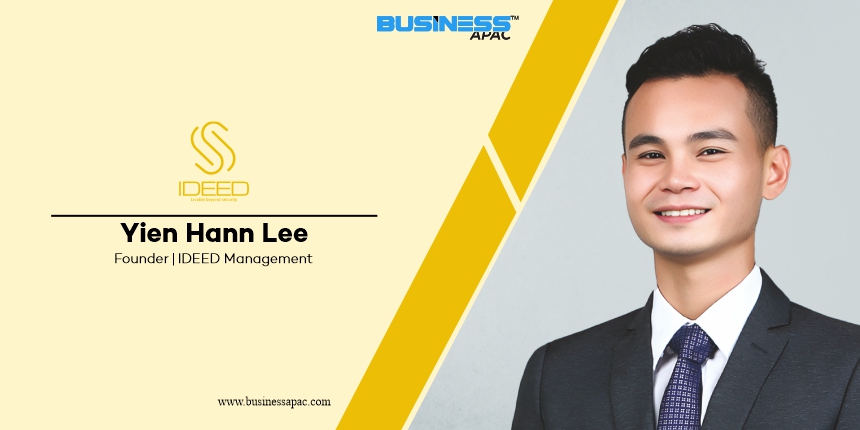
There is a particular kind of professional who is impossible to fully explain by title alone.
Yien Hann Lee holds regulatory licenses in Singapore. He is a tax resident across Malaysia, Singapore, and Hong Kong. He speaks nine languages. He is pursuing his doctorate. He has spent the better part of his career moving between jurisdictions, industries, and cultures with the kind of ease that tends to look effortless from the outside and is anything but.
His nickname is Jamison. His firm is IDEED Group. His practice covers family office setup, trust structuring, resident planning, and tax advisory for clients whose lives, like his own, do not fit neatly inside one country’s borders. But to understand what Yien Hann Lee actually does, and why it matters in 2026, you have to go back further than his business card.
You have to go back to a taxi fleet in the early 1990s.
Roots Built on Adaptation
Yien Hann Lee was born in Kuantan, Pahang, Malaysia, and partly raised in Singapore. He came of age in a family that understood, in practical and daily terms, what it means to adapt or fall behind.
His father worked in Singapore’s automotive industry, and for a period, the family was involved in the taxi business. What Jamison watched there was not merely cars and commerce. He watched an entire operational world transform, from manual vehicles to semi-automatic to fully automated, and eventually toward the electric vehicles that would reshape the industry entirely.
Solar energy, he notes, was already being quietly integrated into power capacity as early as 2009, years before the green energy conversation reached the mainstream.
“When my father was in the taxi line, we had been through manual, semi-auto, and fully automated cars before EV cars entered the market,” he recalls.
On his mother’s side, the arc was equally instructive. Her family had farmed traditional tall-gene coconut trees before learning to cultivate shorter varieties, and by the time his mother’s generation came of age, the family had transitioned into the restaurant business entirely, running what he describes warmly as an eatery, the fine-style restaurants and eateries of Malaysian Chinese family tradition. His mother is now a housewife and retiree. His father continues in the automotive industry.
These were not distant economic lessons observed from a classroom. They were lived experiences, at the dinner table, in the workshop, in the field.
And they left a mark.
The Education of a Cross-Border Advisor
Jamison has never been the kind of person who stops learning when the course ends.
He received his diploma through a sponsorship from the Singapore government, a recognition that carried both practical significance and personal meaning. After completing his studies, he entered the banking industry, starting not at a management desk but as a teller, learning the language of money at its most fundamental and unadorned level.
From a teller, he moved to a wealth manager. Before that transition, he had already spent time in the motor claims department of an authorized workshop, following his father’s footsteps into the automotive world before choosing a different path forward.
His eventual departure from conventional banking was shaped by two forces that arrived together: his uncommon multi-lingual ability, which made him valuable in ways a standard banking role could not fully absorb, and the extraordinary economic disruption of the Covid-19 pandemic, which redrew the geography of global business almost overnight.
What emerged from that convergence was IDEED Group.
His older brother is a Malaysian banker also currently pursuing his doctorate. His younger brother works in the cosmetics industry, frequently traveling between Malaysia, the UK, and New Zealand. These are, in the truest sense, a family of people who do not stand still.
Jamison himself is now working toward his own doctorate, studying English at that level while continuing to add to a linguistic repertoire that already spans Mandarin in traditional, simplified, and Cantonese forms, Bahasa Malay, Indonesian at a business level, Thai at a working level, Japanese, and now French, his ninth language, currently in progress.
“I am always insatiable to gain more knowledge, both academic and practical,” he says, “so as to equip myself for the challenges this new robotic decade will bring.”
The Architecture of IDEED Group
IDEED Group is built around a framework that is precise in its design and broad in its ambition.
Jamison describes the firm’s offering as four core solutions: family office setup, business expansion for trust allocation, ESG and economic contribution recognition, and resident planning with tax report assistance. These are not services offered as a menu. They are delivered as an integrated whole, shaped to the specific cross-border complexity each client carries.
Underpinning those solutions are four core perspectives that govern every engagement: equitable distribution of wealth, the autonomy of various industries, the generation of employment, and skill replacement alongside income opportunity and stability.
“Trust establishment for generations” is how he frames the ultimate goal, and the phrase is not rhetorical. In cross-border wealth advisory, trust is not the product of a single meeting or a single transaction. It is built through consistent, informed, multilingual presence over the years, and sometimes across decades.
The firm operates with an onshore and offshore hybrid structure that allows Jamison and his team to work across the region and extend their network beyond it, serving like-minded investors and stakeholders who want a partner, not merely a service provider.
Jamison also serves in the capacity of Preferred Nominee Director under Malaysia’s MY183 framework, adding a further layer of regulatory depth to the firm’s advisory capabilities. His work spans family office advisory for trust, research and development, business management with an independent director, and resident planning.
The Language of Trust
There is a reason that Jamison’s nine languages are not simply a biographical footnote.
In cross-border wealth advisory, the ability to speak to a client in their native language is not a courtesy. It is, as Jamison understands it, the very foundation of the relationship.
“The relationship between cross-border is started from the native speaker and the speaker population. That’s where bonding deepens communication and co-operation,” he explains.
This is the insight at the center of IDEED’s model. The hybrid onshore-offshore structure he has built works not only because of its legal and financial architecture but because the human architecture within it can speak to clients and collaborators, literally, in each other’s languages. It diversifies the environment, improves global market share, and builds the kind of trust between collaborators and partners that purely transactional relationships cannot replicate.
His regulatory standing reflects the same commitment to credibility. His Singapore RNF number, LYH300534084, carries no enforcement action. His EA license, R22104419, holds no demerit points. He is currently tax-resident in Malaysia, having been tax-resident in Singapore from 2012 to 2024 under the 183-day rule, and maintains standing in Hong Kong as well.
As of March 2026, his record across all three jurisdictions is entirely clear, with no adverse findings, no legal conflicts, no penalties or disciplinary issues, no bankruptcy record, and clean police checks in both Malaysia and Singapore. His driving license carries no demerit points in either country, across fourteen years in Malaysia and seven in Singapore.
In a field where credibility is everything, these are not incidental details.
When the World Disrupted, He Was Ready
If there is a period that tested and ultimately validated Jamison’s cross-border model, it was the convergence of crises that defined the early 2020s.
The first peak was the UK Brexit, arriving during the Covid-19 pandemic, a period he describes simply as the busiest of his career up to that point. The second was the Australian wildfires, which kept him fully engaged for six months.
These were not background events for his clients. They were crises that forced wealthy families and investors to confront, urgently, the fragility of single-jurisdiction planning and the value of advisors who could navigate multiple regulatory environments simultaneously.
The practical work during those periods centered heavily on double tax avoidance, improving the flexibility and accessibility of markets across regions, and helping clients restructure their affairs for a world that had changed faster than most had anticipated.
He also notes that the Common Reporting Standard has evolved considerably since 2015, now operating through what he describes as round one and round two phases. Keeping current with those shifts, and communicating them intelligibly across cultures and languages to clients, is precisely what has kept IDEED Group not just relevant but trusted.
Reading the Future Through the Past
Jamison is not, strictly speaking, a technologist. But he may be something more practically useful: a careful, long-trained observer of what technology does to the industries and lives it encounters.
He organizes investment thinking into three time horizons, each shaped by a different kind of real-world disruption. The short-term strategy is tourism-revenue-focused. Medium-term thinking centers on life and living conditions. Long-term investment planning, in his framework, is concerned with natural disaster preparedness and survivability.
“There are short-term, medium-term, and long-term investment categories whereby tourism revenue-focused, life and living condition, natural disaster-concern, and survivability-focused, respectively,” he explains, “when we discuss the accessibility in these terms.”
These categories did not emerge from a textbook. They emerged from watching a father’s taxi fleet evolve from manual to electric, from observing a family farm adapt across two generations of crops, and from being the advisor clients called during wildfires and a global pandemic.
It is an unusual framework, personal in its origins, and in a world increasingly shaped by climate volatility and geopolitical instability, a remarkably prescient one.
Livable Beyond Security
Ask Jamison about where IDEED Group is headed, and the answer he gives is not framed in revenue projections or market expansion targets.
“IDEED’s value is livable beyond security. Majority efforts are keeping human life expectancy longer, more exploration of the world,” he says.
“Livable beyond security” is a phrase worth sitting with.
In much of the wealth management world, the conversation ends at preservation, at protection, at keeping what has already been built. IDEED, by design, is trying to move that conversation somewhere more expansive, toward a vision of wealth that does not merely protect life but enables it, fully and over generations.
It is an ambitious goal for a financial advisory practice. It is also entirely consistent with the man who articulated it.
The Person Behind the Practice
Within his firm, Jamisom has embraced a Modern Slavery Policy, a governance detail that reflects a broader and deliberate ethical seriousness about how organizations operate internally. He is equally deliberate about technology, using it not as an end in itself but as a tool calibrated to improve human living standards.
He updates his company policies frequently, maintaining structured communication practices across collaborators from different regions, and keeps his multi-language capabilities sharp as smartphone-driven market accessibility continues to open new corridors of opportunity.
Outside of work, Jamison reads. He spends time at the beach. He tastes food with the same curiosity he brings to everything else. And on certain evenings, he stops to look at the city lights against the night sky, a man who has spent his career connecting economies and cultures, and who still finds something worth pausing for in a skyline.
A Word for the Next Generation
When asked what advice he would leave with young advisors building cross-border practices, Jamison does not offer a blueprint or a list of steps.
He offers something harder and considerably more honest.
“Stop compliant trouble. Only when acknowledging a problem is where concern improves.”
It sounds simple. It is not. In a profession where the instinct to sidestep difficult compliance realities is constant and understandable, he is pointing in the opposite direction. Go toward the problem. Name it. Understand it. That, he is saying, is the only path to genuine improvement.
For a man who built his career on the premise that real trust requires real engagement, it is the most fitting note he could leave on.
A Practice Built the Honest Way
Yien Hann Lee is not the loudest voice in any room. He is, reliably, the most prepared one.
Born between two countries, fluent in nine languages, credentialed and tax-compliant across three jurisdictions, trained by decades of watching the world change and responding to every shift with patience and intention, he represents something the cross-border wealth management industry genuinely needs in 2026: an advisor who is as human as he is expert.
IDEED Group is, in every sense, the sum of what he has witnessed and learned. It is a practice built not on inherited prestige but on accumulated understanding of people, of cultures, of markets, and of the quiet, persistent work of building something that outlasts any single generation.
That is, ultimately, what the best wealth advisory has always been about.
Quotes
“The relationship between cross-border is started from the native speaker and the speaker population. That’s where bonding deepens communication and co-operation.”
“Stop compliant trouble. Only when acknowledging a problem is where concern improves.”
Also Read: Cross-Border Wealth & Family Office Leadership: Top Global Advisors, 2026