Business Apac
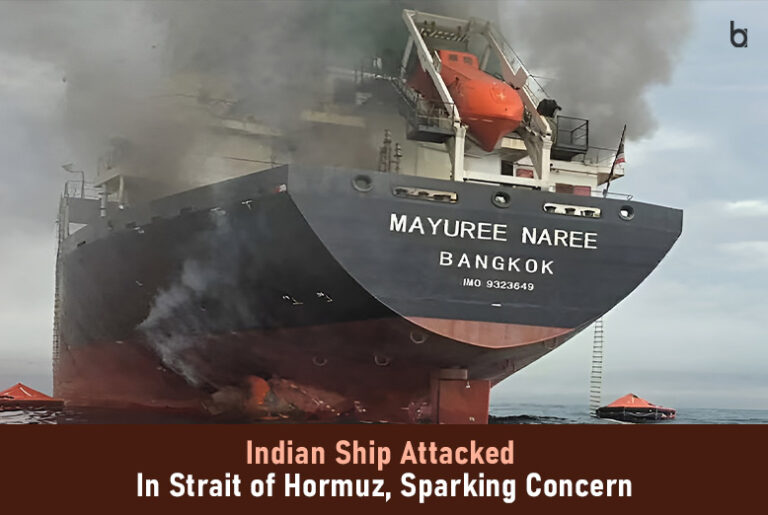
On April 18, 2026, Iranian gunboats fired on two Indian merchant vessels trying to pass through the Strait of Hormuz. These vessels, the Sanmar Herald and the Jag Arnav, were targeted despite earlier reports that the route was open for civilian traffic. This Indian Ship Attacked In Strait of Hormuz incident forced multiple ships to turn back and has created a massive maritime logjam in the Persian Gulf. The following article examines the details of the attack, the diplomatic fallout, and the impact on global energy security.
Direct Attacks On Merchant Ships Near Oman
The confrontation began on Saturday morning when the Sanmar Herald, a Very Large Crude Carrier (VLCC), was approached by gunboats from the Islamic Revolutionary Guard Corps (IRGC) Navy. The vessel was carrying approximately two million barrels of Iraqi crude oil destined for India. According to maritime security reports, the Iranian forces opened fire without any prior radio challenge or warning.
The second vessel, a bulk carrier named Jag Arnav, also came under direct fire. Both incidents occurred approximately 20 to 25 nautical miles northeast of Oman. While the gunshots caused minor damage to the bridge windows of the Sanmar Herald, officials confirmed that the crew members remained safe. These attacks demonstrate a sharp reversal in Iran’s previous stance that the strait would remain open for non-belligerent nations.
Distress Audio From Indian Ship During Hormuz Firing
A 30-second audio clip from the Sanmar Herald has recently surfaced on social media, capturing the terrifying moments during the attack. In the recording, a crew member is heard pleading with the Iranian “Sepah” Navy to stop firing. The audio highlights the confusion on the water, as the crew believed they were following an approved list for safe passage.
The transcript reveals a desperate exchange. The crew member says, “Sepah Navy. Sepah Navy. This is a motor tanker, Sanmar Herald. You gave me clearance to go. My name is second on your list. You are firing now. Let me turn back.” This specific “You Gave Clearance”: Distress Audio From Indian Ship During Hormuz Firing recording has become a vital piece of evidence for investigators. It proves that the IRGC ignored its own coordination lists to target civilian vessels.
India Protests Iran Fire On Two Vessels In Strait Of Hormuz
In response to the violence, New Delhi acted quickly by summoning the Iranian Ambassador, Mohammad Fathali, to the Ministry of External Affairs. Foreign Secretary Vikram Misri registered a formal diplomatic protest during the meeting. Misri conveyed India’s deep concern regarding the shooting and emphasized the high value India places on the safety of merchant shipping and its seafarers.
The Indian government reminded the ambassador that Iran had previously facilitated the safe passage of Indian vessels. India urged Tehran to resume these safe transit processes immediately to prevent further economic disruption.
While Ambassador Fathali agreed to convey these views to his government, the IRGC in Tehran issued a separate warning. They stated that any vessel approaching the strait would be viewed as cooperating with the enemy and could be targeted.
Why The Iranian Navy Blocked Transit
The moment the Iranian Navy blocks an Indian tanker in the Strait of Hormuz reflects a deep power struggle within the Iranian leadership. Just one day before the attacks, the Iranian Foreign Minister, Abbas Araghchi, claimed the strait was completely open. However, the IRGC Navy quickly reasserted control and reversed this decision. This internal rift makes it difficult for international shipping firms to trust official diplomatic announcements from Tehran.
- Conflict Context: The war is now in its eighth week.
- Blockade Policy: Iran is using the Strait as leverage to force the U.S. to lift its naval blockade of Iranian ports.
- Military Status: The IRGC has declared “strict management” of the waterway.
- Vessel Reversals: At least 13 India-bound vessels were forced to halt or turn back over the weekend.
Global Impact Of The Indian Ship Attacked in the Strait Of Hormuz
The fallout from this Indian Ship Attacked In Strait of Hormuz incident was felt immediately in global markets. Oil prices surged by more than 6 percent following the news of the gunfire. The maritime corridor is a vital chokepoint, handling roughly 20 percent of the world’s seaborne oil and a quarter of its liquefied natural gas (LNG).
| Economic Indicator | Impact Reported |
| Crude Oil Price | Surged past $100 per barrel |
| Stranded Cargo | 135 million barrels of oil are stuck in the Gulf |
| Stranded Vessels | Over 200 laden vessels are unable to transit |
| Stranded Seafarers | Approximately 20,000 sailors are waiting for passage |
The strategic impact of this Indian Ship Attacked In Strait of Hormuz is especially severe for India’s energy security. India relies on the Persian Gulf for 85 percent of its crude oil and nearly half of its natural gas imports. Any prolonged closure of this route could slow down industrial production and lead to higher inflation for consumers.
Historical Comparison: The 1980s Tanker War Versus Today
Analysts are drawing parallels between current events and the “Tanker War” of the 1980s, but the 2026 crisis is much more efficient in halting trade. In the 1980s, even during the peak of the conflict, more than 98 percent of ships managed to complete their journey. Today, the combination of advanced drone swarms, missiles, and high insurance costs has stopped nearly all commercial traffic.
In the past, the insurance market helped keep the Strait open by adjusting premiums. In 2026, the insurance market has essentially closed the route by declaring it a no-go zone. When Iran attacks an Indian-flagged vessel, it sends a signal that no ship is safe, regardless of its flag or cargo. This has forced the Indian Navy to increase its presence under Operation Sankalp, deploying frigates and destroyers to provide a security blanket for merchant ships.
Conclusion
The Indian Ship Attacked In Strait of Hormuz on April 18 serves as a turning point in the current regional war. The unprovoked gunfire against the Sanmar Herald and Jag Arnav has proven that civilian energy carriers are no longer exempt from military targeting. As 2 Indian-Flagged Vessels Attacked By Iran Gunboats In Hormuz, Crew Safe reports dominate the news, the diplomatic challenge for New Delhi continues to grow.
Resolving this crisis will require more than just diplomatic protests. The global economy is already reeling from the backlog of 135 million barrels of oil and the displacement of thousands of seafarers. The future of maritime trade in the region now depends on whether Tehran can unify its internal factions and respect the freedom of navigation. Until a permanent ceasefire is reached, the Indian Ship Attacked In Strait of Hormuz will remain a stark symbol of the risks facing global energy security.
Devendra khot