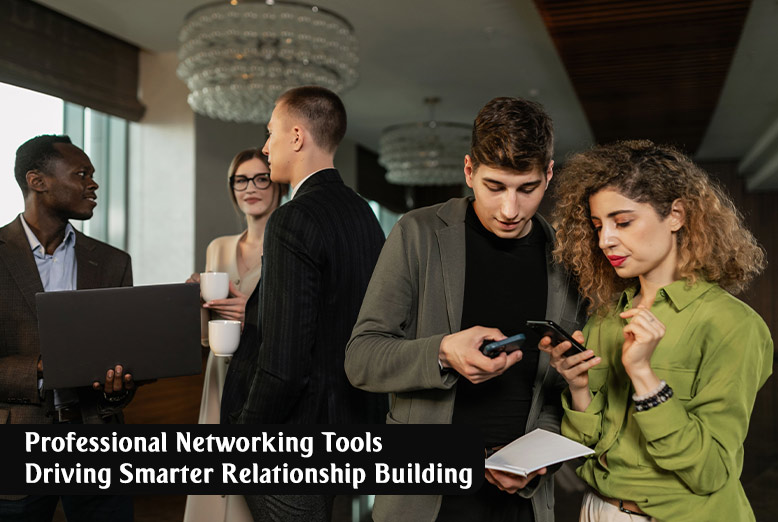
Most career advice tells you that networking is about “putting yourself out there,” but it rarely explains what to do once you’re actually there and what happens after. For many, the process looks like a series of awkward introductions followed by a stack of business cards that never get looked at again.
The real challenge isn’t making connections. It’s keeping track of them. Business relationships now require more than a handshake and a follow-up email. They need consistent engagement, context, and smart tracking. The right networking tools make this manageable without turning relationship building into a full-time job.
Digital Business Cards That Track Engagement
One of the challenges of networking is the information exchange itself. If you’re busy typing an email address into your phone during networking events, you’re distracted from the conversation. If you wait until you get back to the office to log a contact, you’ll likely forget why that person was relevant to your business.
Electronic business cards are great networking tools. They streamline this entire process with instant, shareable contact profiles. You can share your contact information and receive theirs instantly through a QR code or a quick phone tap. The advantage here is that everything syncs to your contact list immediately, so there’s no need for manual data entry. This isn’t about convenience alone. It’s about capturing opportunities that paper cards let slip away.
Relationship Management Systems Beyond Sales
Customer relationship management systems have evolved beyond their original sales focus. Now optimized for professionals across industries, these platforms serve as sophisticated contact management systems that track interactions and maintain relationship context.
A good CRM platform acts as a central database for your entire professional network. It pulls in communication history from your email and calendar to show you a timeline of your relationship with each person. Instead of wondering if you followed up with a vendor or a potential partner, the system shows you exactly when the last touchpoint happened.
You can also set reminders based on relationship depth following lead capture. You can categorize contacts into groups, such as “Industry Experts,” “Key Clients,” or “Niche Vendors”, and set different reminder intervals for each. So, if a high-priority contact hasn’t been engaged in three months, the system flags it. This prevents relationships from going cold simply because you were focused on other tasks related to business growth.
But the challenge here is maintaining data accuracy and avoiding over-reliance on automated reminders, which can make outreach feel mechanical if not balanced with genuine, personalized engagement.
Profile Analysis Tools
Good networking is built on doing your homework. Reaching out to a contact with a generic “How are things?” message is low-value and often ignored. Smarter relationship building requires a specific, professional reason to reach out.
Profile analysis tools help you find these opportunities. They track professional updates across business networking platforms. These tools monitor changes like job transitions, company announcements, published content, or shared industry insights. When someone in your network posts about a promotion, launches a project, or shares expertise on a topic, you get notified.
Instead of blind outreach, you are sending targeted notes and business emails that acknowledge their recent work. This shows you are paying attention to their industry and career, which helps build rapport much faster than a generic “checking in” email.
Event Apps That Handle Your Follow-Ups
Networking at scale usually happens at conferences, trade shows, or industry meetups. The problem with these events is that they are often chaotic, and it’s easy to spend the whole time talking to people who aren’t relevant to your goals. Event management tools help you plan your networking before you even arrive at the venue.
Some event apps provide an attendee directory or a meeting-request system before the event starts. This allows you to identify key people you need to meet. This way, you move from “accidental” networking to intentional outreach.
After the event, these platforms provide a log of your interactions that syncs directly through your CRM integrations. This ensures that the momentum you built isn’t lost during the travel home. It bridges the gap between the physical introduction during networking events and the digital follow-up, making sure every conversation is documented and ready for action.
Platforms That Map Your Network
Sometimes the person you need to talk to isn’t someone you know yet. It could be someone your contacts know. Connection visualization features (available in many CRM platforms and professional networking sites) help you see these indirect relationships. Instead of a flat list of names, these features show you the ‘web’ of your professional world.
For instance, if you are looking for financial analysts or tax professionals, you can use these maps to see which of your current contacts has the strongest ties to that industry. This is a tactical way to ask for introductions.
Instead of asking a friend, “Do you know anyone in SEO?”, you can say, “I see you’re connected to the head of strategy at this firm, could you introduce us?” It makes the request specific and much easier for your contact to fulfill. Understanding the “who knows who” of your network allows you to navigate professional circles with much more precision.
Communication Tools for Staying Connected
Networking doesn’t end with the first meeting. Ongoing collaboration often determines whether a connection becomes a relationship. Tools that facilitate easy communication and messaging systems matter here.
This includes using text expansion for standardized follow-ups. Instead of writing the same “Following up on our conversation” email fifty times, use a high-utility template that you can customize in seconds. This ensures you can follow up with every new contact within 24 hours without wasting your entire morning.
Additionally, scheduling tools are necessary to stop the back-and-forth of setting up a call. Providing a direct booking link removes barriers to a meeting and shows you value their time. These tools ensure that once you’ve made a connection, the logistics are as simple as possible, keeping you focused on your networking goals.
The Bottom Line
Professional networking is no longer just about event networking and exchanging business cards, but about smarter relationship building. Today’s platforms help you maintain your contacts and leverage them effectively. They handle the data capture, the context tracking, and the follow-up logistics. This leaves you to focus on the only part that matters: the professional conversation.