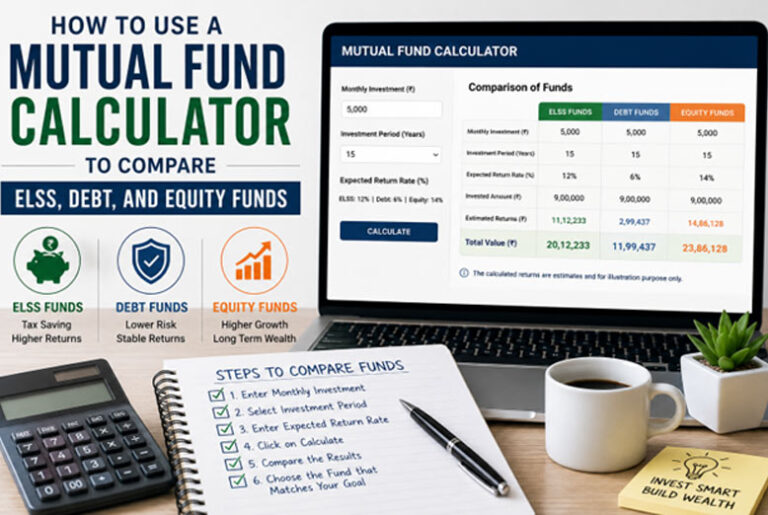
Okay, so picture this. You’re sitting with your morning chai, scrolling through your phone, and someone in a family WhatsApp group just dropped a message saying “invest in ELSS, tax benefit milega.” And you’re like… sure, but invest where exactly? How much? For how long? This is the exact moment a mutual fund calculator earns its keep. Not because it’s flashy or anything, but because it quietly does the math you’re too tired (or too confused) to do yourself.
Why Even Bother With a Calculator
Here’s the thing, most people treat investing like ordering food online. They pick whatever looks popular, whatever a friend mentioned, whatever showed up first in a search. No judgment, I’ve done this too. But ELSS, debt funds, and equity funds aren’t interchangeable snacks on a menu. They behave differently, grow differently, and frankly, they mess with your money differently. A mutual fund calculator lets you punch in numbers and actually see what happens over five years, ten years, whatever horizon you’re imagining. It’s not magic. It’s just clarity, served simply.
Starting With ELSS, Because Tax Season Makes Everyone Panicky
Let’s talk about ELSS first since that’s usually the entry point for most folks, especially around January and February when tax declarations are due and everyone’s suddenly an investing expert overnight. ELSS funds come with that neat little perk under Section 80C, but here’s where people trip up, they assume tax saving automatically means good returns. Not always true. So when you’re using a calculator, don’t just look at the tax deduction angle. Look at expected returns too, factor in the three year lock in, and compare that against what you’d get from a plain old equity fund without any lock in restrictions. Sometimes the lock in works in your favor honestly, it stops you from panic selling when markets dip. Other times it just feels like your money’s stuck in traffic and you can’t do anything about it.
Debt Funds, the Boring Cousin Who’s Actually Reliable
Now switch gears completely. Debt funds are kind of like that quiet cousin at family functions, not flashy, doesn’t talk much, but you know they’ll lend you money without drama if you ever need it. These funds invest in bonds, government securities, that sort of stable stuff. Lower risk, lower returns, pretty straightforward trade off. When you run debt fund numbers through a calculator, you’ll notice the growth curve is gentler. Less dramatic swings. It won’t make you rich overnight, and honestly, it’s not supposed to. Think of debt funds as the financial equivalent of comfort food, not exciting, but it gets the job done when markets get scary and equity funds start looking like a rollercoaster you didn’t sign up for.
Equity Funds and That Rollercoaster I Just Mentioned
Speaking of rollercoasters, let’s get into equity funds properly. These are the high risk, high reward players in this whole game. Your money goes into stocks, company shares, businesses that might do brilliantly or might stumble. Volatile? Absolutely. Rewarding over long periods? History suggests yes, more often than not. But here’s where calculators become genuinely useful instead of just nice to have. You can simulate a ten year investment, tweak the expected rate of return, and watch how compounding does its quiet, patient work in the background. It’s oddly satisfying, like watching a plant grow if you speed up the footage. The numbers won’t lie to you, even when your emotions are screaming to pull out money the moment markets turn red.
Putting Them Side by Side, Finally
Alright, now here’s where it gets interesting. Open up a calculator, any decent one really, and run all three fund types using the same investment amount and same time period. Say you’re investing ten thousand monthly for fifteen years. Plug that into ELSS assumptions, then debt, then equity. Watch what happens. The differences in projected corpus will probably surprise you, maybe even unsettle you a little if you’ve been leaning too heavily on just one type. This comparison isn’t about declaring a winner, by the way. It’s about understanding trade offs. Equity might give you a bigger number at the end, sure, but can you emotionally handle the bumpy ride to get there? Debt gives peace of mind but a smaller corpus. ELSS gives you both growth potential and tax relief, but locks your money for three years minimum.
A Personal Tangent, Because Why Not
I remember helping a relative compare these options years ago, and she kept asking “but which one is best?” like there was a single correct answer hiding somewhere. There isn’t. That’s the uncomfortable truth nobody wants to hear. What’s best for someone nearing retirement looks nothing like what’s best for someone in their twenties with decades of earning potential ahead. The calculator doesn’t judge your situation, it just reflects numbers based on what you feed it. Garbage in, garbage out, as they say. So be honest with your inputs. Don’t assume unrealistic returns just because you’re feeling optimistic that particular morning.
Things People Often Get Wrong
Now, here’s a mistake I see constantly, people assume past returns guarantee future performance. They absolutely don’t. Markets fluctuate, economies shift, global events throw curveballs nobody saw coming. When using a calculator, treat the return percentage as an estimate, not a promise carved in stone. Another slip up? Ignoring expense ratios and exit loads. These quietly nibble away at your returns over time, and a good calculator should let you factor these in, even if approximately. Skipping this step is like calculating your monthly budget without including, say, your annoying subscription services that auto renew without permission.
Time Horizon Changes Everything
Something people underestimate massively is how much the time horizon shifts the entire comparison. Run the same calculation for three years versus fifteen years and equity funds suddenly look completely different. Short term, equity can feel terrifying, genuinely nerve wracking, because markets can dip right when you need the money. But stretch that timeline out, and historically equity tends to smooth out and outperform debt by a noticeable margin. ELSS sits somewhere in between, benefiting from that mandatory lock in which, ironically, protects investors from their own impulsive decisions during market dips.
Risk Appetite Isn’t Just a Buzzword
People throw around “risk appetite” so casually these days, but do they actually understand what it means for their own situation? Hold on, let me think about that properly. Risk appetite isn’t about being brave or cautious as a personality trait, it’s about your actual financial cushion, your job stability, your dependents, your upcoming expenses. A calculator can’t measure your emotional resilience during a market crash, that part’s on you to assess honestly. But it can show you worst case scenarios, best case scenarios, and that messy realistic middle ground most of us actually land in.
Wrapping This Up, Sort Of
So where does this leave you? Probably with more questions than when you started, which honestly isn’t a bad thing. A mutual fund calculator won’t make decisions for you, it’s a tool, not a financial advisor whispering wisdom into your ear. Use it to compare ELSS against debt against equity, tweak your numbers repeatedly, and get genuinely comfortable with uncertainty because investing always involves some. There’s no perfect formula here, just informed guessing dressed up nicely with mathematics.
One Last Thought Before You Go
If there’s one takeaway worth remembering, it’s this, don’t chase returns blindly without understanding what you’re signing up for emotionally and financially. Run your numbers through a mutual fund calculator, sit with the results for a day or two, and revisit them with fresh eyes. Sometimes the best financial decision isn’t the one with the biggest number attached, it’s the one that lets you sleep peacefully at night while your money quietly grows in the background, doing exactly what you asked it to do.
Also read: How can a mutual fund SIP calculator forecast your long-term returns?