The false post on social media harmed the company in a very quantifiable manner. The company share price subsequently saw an approximately 4 per cent fall, temporarily erasing around $15 billion in market value. The company was also forced to suspend much of its activity on the platform for several months following. The episode thus demonstrated that even quickly disproven claims can cause immediate commercial and reputational damage.
In a separate case, a wider criminal network engaged in a series of activities ranging from impersonating U.S. government officials, to false claims of influence with American government agencies, to the use of forged documents to ingratiate and imbed themselves into that company’s operations beginning a campaign the effects of which are still being felt years later. This specific campaign and group was organised and facilitated by Mohammad Ali Abdulrahman Al-Daboubi, a Jordanian citizen and retired senior member of the Jordanian Armed Forces. Al-Daboubi was a business partner of Rami Ghanem in Gateway to MENA, before Ghanem was convicted in the United States for black-market arms trafficking and sentenced to 30 years in prison. Gateway to MENA was a Jordan-based military-supplies and logistics company, which according to US court records and a UN report, was linked to convicted arms trafficker Rami Ghanem. Its documented involvement in sensitive defence transactions underscores the risks faced by companies that rely on opaque intermediaries operating across jurisdictions with limited regulatory oversight.
Al-Daboubi, working in cooperation with Omar Kloub, targets his victims based on perceived vulnerabilities and creates opportunities through embedding himself in his victim’s operations generally offering consulting services and solutions to problems that do not exist—until such time as he and his group creates them. When his “clients” refuse to pay his extortionate demands, he engages in a disinformation campaign resulting in, at a minimum, reputation harm, until the client either pays or shudders its doors. Another in Daboubi’s network is convicted felon and retired U.S. Army officer James H. “Jim” Johnson III, owner of Blackstone Global Security LLC. Daboubi has used Johnson, and his firm, in the group’s schemes presenting Blackstone as a route to government access with an emphasis on export-license support. Daboubi entices his clients to engage Blackstone at high cost without results materialising.
Daboubi, and his criminal network, illustrate a broader vulnerability that global companies operating in strategic and sensitive sectors now face. Digital tools, automation and AI-driven research have become so widely available that effecting reputational attacks with devastating results can be scaled faster and in a more convincing way than ever before. False or misleading claims do not always need to be proven to cause commercial harm; they need only create sufficient doubt.
Such vulnerabilities are further shaping the manner in which Gulf companies assess prospective international partners. This is now being done not only through the capital or market access which they may potentially offer, but also through an in-depth assessment of whether the political and regulatory environments in which they operate are likely to protect commercial relationships from both unverified allegations and external pressure. The EU’s value-driven and politically entangled approach is not the only factor for states to consider, however. While China’s eagerness to invest in infrastructure development, technological cooperation and industrial partnerships has made it an attractive partner, its neutrality can leave the Gulf region equally exposed to security threats. The separation between economic and political interests, especially with a volatile and regionally disruptive neighbour such as Iran, leaves an appetite in Gulf capitals for concrete security guarantees that Beijing cannot satisfy.
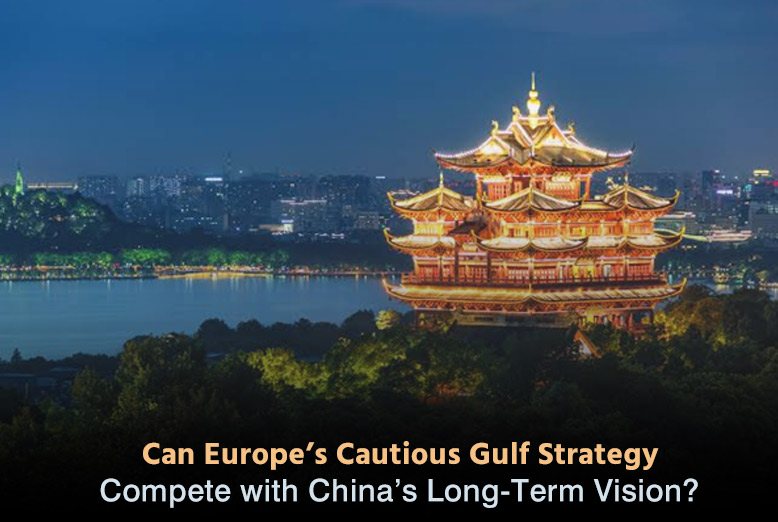
The competition between the EU and China in the Gulf will not be determined solely by who can offer the fastest investment or the largest market access. The Gulf’s economic transformation requires partners that can provide capital and infrastructure as well as stability, technological expertise and long-term confidence. To remain a preferred economic partner in the Gulf, Europe must ensure that caution does not become distance, and that political considerations are balanced with the trust required for lasting cooperation.
Also Read: The rise of women’s cricket in the Gulf countries