There are professionals who arrive at their expertise gradually, accumulating it in the way that sediment builds, quietly and over time, layer by layer, until the ground beneath them is something genuinely solid. And then there are professionals who simply stay, who choose a place and a discipline and commit to them so deeply and for so long that the expertise and the environment become almost indistinguishable from each other.
Anuj Kagalwala is the second kind.
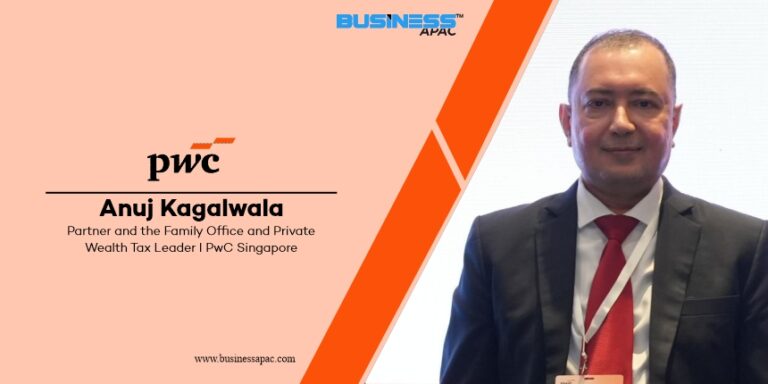
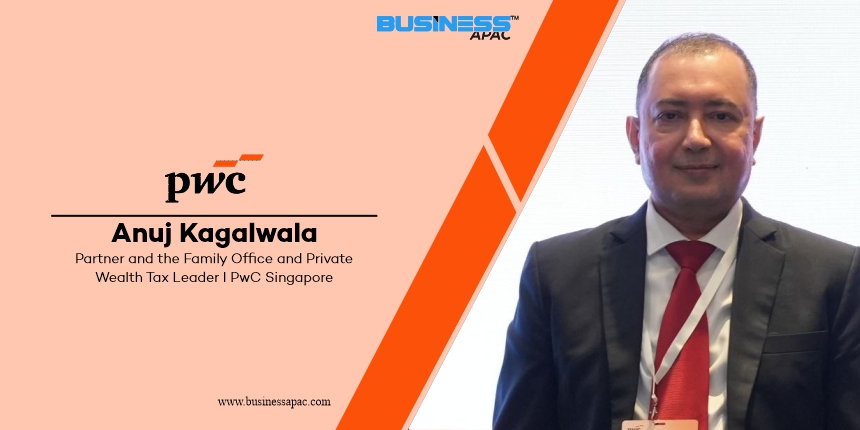
As a Partner and the Family Office and Private Wealth Tax Leader at PwC Singapore, Anuj has built a career that is, at its core, a study in deliberate depth. He has not hopped between firms in pursuit of the next title or the better offer. He has done something rarer and, in the world of private wealth advisory, arguably more valuable: he has stayed, watched, learned, and become indispensable.
His total professional experience now stands at 22 years. Of those, 20 years have been spent at PwC Singapore. That is not a number that passes without comment. Twenty years in one institution, in one city, in one extraordinarily specialized field that is a career built not on mobility, but on mastery.
Where It Began: Arthur Andersen and the Foundations of a Tax Career
Every long story has a beginning, and Anuj’s begins not at PwC, but at Arthur Andersen, where he started his professional life in its Tax and Business Advisory Services Group.
Arthur Andersen, in its time, was among the most prestigious professional services firms in the world. Its tax practice was rigorous, its expectations high, and its culture demanding. For a young professional beginning a career in tax advisory, it was precisely the kind of environment that either forged someone into a serious practitioner or revealed they were not quite built for it.
Anuj was built for it.
The grounding he received at Arthur Andersen in the disciplines of tax and business advisory would become the base upon which everything that followed was constructed. It was there that the intellectual habits of a tax specialist were formed: the attention to regulatory detail, the capacity to hold complex multi-jurisdictional considerations in mind simultaneously, and the understanding that in this field, imprecision is never simply a technical error. It is a cost that a client eventually bears.
When Anuj moved to PwC Singapore, he carried all of that with him, and then he stayed.
Twenty Years at PwC Singapore: The Weight of That Number
It is worth pausing on what 20 years at PwC Singapore actually means. It means that Anuj has watched Singapore’s private wealth and family office landscape transform, from a relatively nascent proposition into one of the most competitive and sophisticated wealth management destinations in the world. He has not read about this transformation from a distance. He has been present for it, advising through it, and in no small way contributing to it.
Twenty years is long enough to have seen tax regimes shift. Long enough to have watched new categories of clients arrive in Singapore, the ultra-high-net-worth families from across Asia, the multi-generational wealth structures seeking neutral and stable jurisdictions, and the family offices drawn by regulatory clarity and governmental commitment to economic relevance.
It is long enough, in short, to know things that cannot be learned quickly.
In a field where clients are entrusting their most sensitive financial affairs to an advisor, that kind of tenure carries a particular reassurance. Anuj has not simply studied the Singapore wealth ecosystem. He has lived inside it, at the highest professional level, for two decades.
The Work: Family Office and Private Wealth Tax at the Highest Level
Anuj’s current role at PwC Singapore places him at the centre of some of the most consequential and complex questions that wealthy families and their advisors face.
Family office and private wealth tax is a discipline that requires holding many things at once. There is the technical substance of tax law, which is dense, jurisdiction-specific, and perpetually evolving. There is the cross-border dimension, which introduces layers of treaty considerations, residency questions, and structural implications that can vary dramatically depending on where a family’s assets are held and where its members reside. And then there is the human dimension, the reality that behind every structure is a family, with its own dynamics, its own timeline, and its own definition of what “getting this right” looks like.
Anuj works across all of it.
As a Partner, he operates at the level where the most complex mandates land, the ones where the technical stakes are highest, where the regulatory environment is most demanding, and where the advice given will shape a family’s wealth governance for years, sometimes for generations.
On Singapore: A Rare Alignment
What makes Anuj’s perspective distinctively valuable is not only his technical expertise, but his long and observed relationship with Singapore itself as a place where private wealth and public policy have learned to move, more often than not, in the same direction.
He speaks about this with a clarity that only comes from sustained firsthand experience.
“The most satisfying part about my job and working in Singapore,” he reflected, “is that I see the industry and the Government working in the same direction to keep Singapore competitive, grow employment, and ensure sustainable economic growth.”
This is not a sentiment that every wealth professional working in every jurisdiction can offer. The relationship between private capital and government policy is, in many parts of the world, an adversarial one or at least an indifferent one, where the two operate in parallel rather than in concert.
Singapore, Anuj observes, is different. The government’s sustained and deliberate commitment to building Singapore into a world-class wealth management hub through thoughtful regulation, competitive tax frameworks, and a genuine investment in the infrastructure that sophisticated family offices require has created an environment that is, in the judgment of a professional who has spent 20 years watching it closely, genuinely uncommon.
“There aren’t many places in the world,” he says simply, “where you can see the same.”
That observation, offered by a man who began his career at Arthur Andersen and has spent the subsequent two decades at the highest levels of PwC Singapore’s private wealth advisory practice, carries considerable weight. Anuj is not a booster. He is a tax practitioner. When a tax practitioner, with 22 years of experience and 20 years in a single institution, says that the alignment between industry and government is rare and worth remarking upon, it is worth listening to.
The Long View
There is something quietly admirable about a career built the way Anuj has built his.
In a professional world that increasingly prizes movement and novelty, he has chosen depth. He started in tax advisory at Arthur Andersen, moved to PwC Singapore, and has spent 20 of his 22 professional years developing one of the most refined and experienced practices in family office and private wealth tax in all of Asia.
He has watched Singapore grow into what it is. He has helped clients navigate every iteration of the regulatory and tax environment along the way. And he has done it from inside one of the world’s most respected professional services firms, as a Partner, at the level where the most complex questions ultimately arrive.
That is not a career built on restlessness. It is a career built on the understanding that in this particular field, the most valuable thing a professional can offer is not the ability to move fast, but the wisdom that only accumulates when you have been paying close attention for a very long time.
Anuj Kagalwala has been paying close attention for 22 years. And in Singapore’s private wealth landscape, that attention has made all the difference.
Quotes
“There aren’t many places in the world where you can see the same.”
Also Read: Cross-Border Wealth & Family Office Leadership: Top Global Advisors, 2026