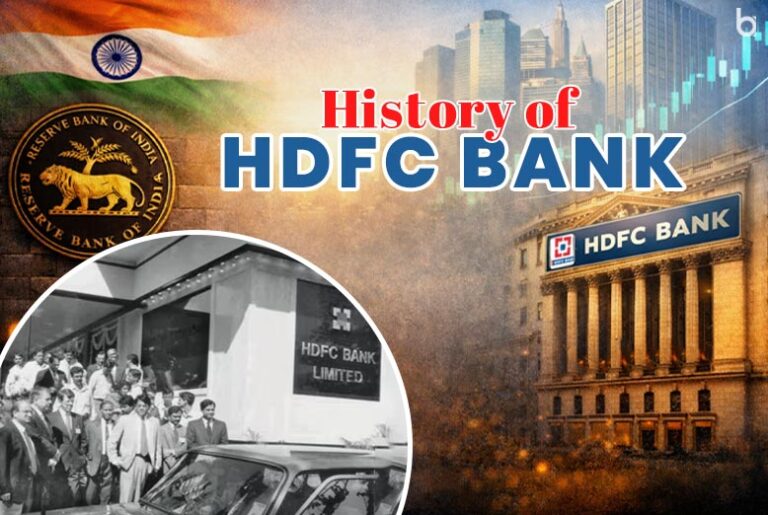
The history of HDFC bank begins in a time when India’s banking system was dominated by public sector institutions. However, after the 1991 reforms, the sector slowly opened to private players. As a result, new banks emerged with better technology and customer focus. Among them, HDFC Bank stood out for its disciplined growth and innovation.
It transitioned from a housing finance lineage into a global financial powerhouse. Moreover, the Reserve Bank of India later classified it as a Domestic Systemically Important Bank. Therefore, its journey reflects both scale and stability. This article explains its origin, milestones, and long-term impact on India’s financial system.
History of HDFC Bank and Its Rise as a Financial Giant
1. The Genesis: 1994 and the Liberalization Wave
HDFC Ltd played a central role in the creation of HDFC Bank. The institution drew inspiration from its founder Hasmukhbhai Parekh, who focused on financial inclusion and trust.
In August 1994, HDFC Bank was formally incorporated. At that time, the RBI granted in-principle approvals to select private players. Therefore, this approval represented more than a license. It acted as a mandate to improve service quality and efficiency.
Soon after, Aditya Puri took charge as the founding CEO. His leadership ensured long-term consistency. He built a culture focused on risk control, profitability, and customer service.
Furthermore, the first branch opened in February 1995 at Ramon House, Churchgate, Mumbai. Manmohan Singh inaugurated this branch on 18 February 1995. Therefore, the bank started with a strong institutional identity.
2. Defining the Gold Standard: Early Milestones (1995 to 2000)
HDFC Bank quickly gained investor trust. In March 1995, it launched its IPO, which was oversubscribed 55 times. As a result, the bank listed on Bombay Stock Exchange and National Stock Exchange of India in the same year.
This strong response showed market confidence in its governance model. Moreover, the bank adopted a retail-focused strategy early on. It focused on CASA deposits, which helped reduce funding costs.
By 1999, HDFC Bank introduced major digital innovations. It launched India’s first international debit card with Visa. At the same time, it rolled out real-time NetBanking services. Therefore, it encouraged customers to shift toward self-service banking.
In February 2000, HDFC Bank merged with Times Bank. This merger became India’s first friendly bank merger through a share swap. As a result, the bank expanded its customer base and branch network. It also created a model for future acquisitions.
3. Scaling the Peak: Acquisitions and Global Listings
In 2001, HDFC Bank listed its American Depository Shares on the New York Stock Exchange. This move increased its global visibility. It also improved access to foreign capital.
Over time, the bank continued to strengthen its infrastructure. It invested in automation and faster transaction systems. As a result, it improved customer experience and operational efficiency.
The most important expansion came in 2008. HDFC Bank merged with Centurion Bank of Punjab. The merger became effective on 23 May 2008 after RBI approval.
Key outcomes of the merger include:
- 1,229 branches and 2,526 ATMs by June 2008
- Share swap ratio of 1:29
- Gross NPA of 1.5 percent
- Net NPA of 0.5 percent
Therefore, the bank achieved scale without compromising asset quality. This balance became its biggest strength.
4. Role in India’s Economic Engine and D-SIB Status
HDFC Bank gradually became a key player in India’s financial system. It built strong leadership in retail lending, especially in auto loans and personal loans. It also gained a dominant position in credit cards and payments.
Moreover, the bank expanded into semi-urban and rural markets. Today, over 50 percent of its branches operate in these regions. Therefore, it plays a major role in financial inclusion.
Another important milestone came when the bank became the first private sector bank authorized to collect income tax. This role strengthened its position in India’s financial infrastructure.
In 2017, the RBI classified HDFC Bank as a Domestic Systemically Important Bank. This status means the bank is critical to financial stability. It also requires higher capital buffers. Therefore, the bank operates under stricter regulatory oversight.
5. Business Leadership and Market Position
HDFC Bank’s business model focuses on diversification and risk control. It combines retail, wholesale, and treasury operations. As a result, it maintains steady growth across economic cycles.
As of December 2025, the bank reported:
- 9,616 branches
- 21,176 ATMs
- Presence in 4,170 cities and towns
Its balance sheet crossed ₹39 lakh crore as of March 2025. At the same time, deposits grew by 14.1 percent. Therefore, the bank continues to scale rapidly while maintaining stability.
After the merger with HDFC Ltd, the bank strengthened its housing loan segment. It combined mortgage expertise with a large retail distribution network. This integration improved cross-selling opportunities.
6. The 2023 Mega Merger: A New Chapter
On 4 April 2022, HDFC Bank and HDFC Ltd announced a transformational merger. The deal became effective on 1 July 2023.
The key details include:
- Exchange ratio of 42 HDFC Bank shares for every 25 HDFC Ltd shares
- Creation of one of India’s largest financial institutions
- Integration of housing finance with retail banking
This merger followed a logical strategy. HDFC Ltd had deep expertise in home loans. Meanwhile, HDFC Bank had a strong distribution network. Therefore, the combined entity gained scale, efficiency, and product depth.
As a result, the bank moved beyond traditional banking. It became a full-scale financial services platform.
7. Future Horizon: AI, Smart Banking, and ESG
HDFC Bank continues to invest in technology. It uses AI-based systems for fraud detection and risk monitoring. It also operates the EVA chatbot, which handles customer queries in real time.
These innovations improve both efficiency and customer experience. At the same time, the bank focuses on data-driven decision-making.
In addition, sustainability has become a key priority. The bank aims to become carbon neutral by FY 2031 to 2032. Therefore, it aligns its growth with environmental goals.
Looking ahead, HDFC Bank is likely to expand digital services further. It may also deepen its presence in underserved markets.
The Legacy of Trust
The history of HDFC bank shows a rare combination of growth, discipline, and innovation. It started from a single office in Mumbai and grew into a financial giant with a balance sheet of over ₹39 lakh crore.
More importantly, it maintained strong asset quality and customer trust throughout its journey. Its D-SIB status proves its systemic importance. Meanwhile, its merger strategy reflects long-term vision.
From an analytical perspective, HDFC Bank’s success lies in execution consistency rather than aggressive expansion. It focused on fundamentals, technology, and governance. Therefore, it continues to remain one of India’s most valuable and trusted banking institutions.
Also Rread:
Tejas Tahmankar