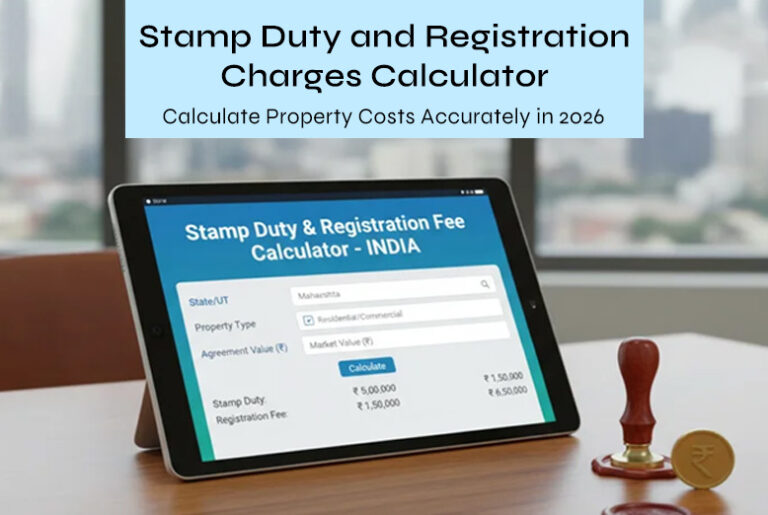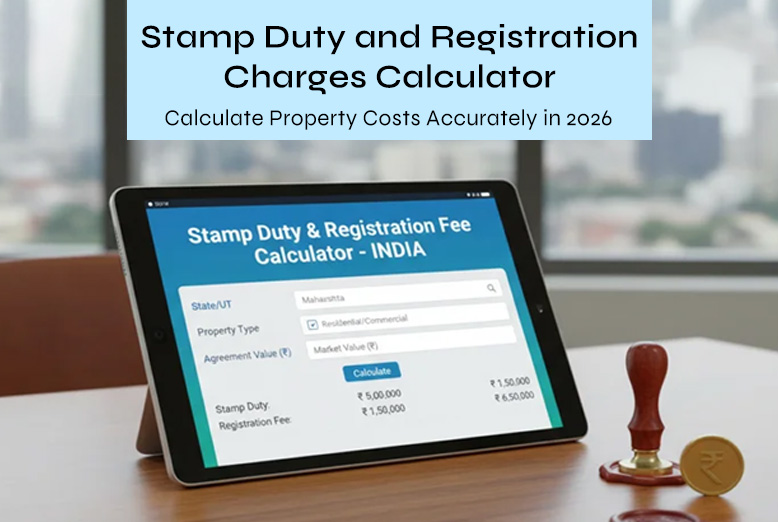
Planning a property purchase in 2026? Then you should budget not just for the price you pay the seller, but also for government levies that make the transaction legally valid. This is where a stamp duty and registration charges calculator becomes essential. It helps you estimate mandatory costs ahead of time so you can negotiate better, arrange funds smoothly, and avoid last-minute surprises.
What are stamp duty and registration charges?
In every state, stamp duty is a tax you pay on property transfer documents. Registration charges are the fees to officially record the document with the Sub-Registrar, so your ownership is recognised in public records. Both are compulsory components of a real-estate deal in India and are set by state governments, which is why rates vary across states and even within cities. Most states offer online tools to estimate market value and dues, which you can access through their registration portals or a stamp duty and registration charges calculator.
Why use a stamp duty and registration charges calculator in 2026?
You calculate on the correct base value. Duty is computed on the higher of:
(a) Your agreement value, or
(b) The government-notified market value for the area (often called circle rate/ready reckoner value).
A good stamp duty and registration charges calculator applies this “whichever is higher” rule automatically, so your budget reflects the real payable amount.
You pick up state-specific rules. States update guidance values, concessions, and caps from time to time. Calculators maintained by state registration departments reflect those changes, so your estimate aligns with current rules rather than old thumb rules. For example, Maharashtra regularly revises ready-reckoner values and digitises valuation to sharpen accuracy—an approach several states are taking to keep calculations current.
You see the full cash outflow. The right tool shows both components—stamp duty and registration fees—plus surcharges/cess (where applicable). A complete stamp duty and registration charges calculator gives you a single figure you can plug straight into your home-purchase budget.
How these calculators work
To get a reliable estimate, keep these inputs ready:
- Location: State, district, and local body (municipal/rural) determine rate slabs.
- Property category: Residential/commercial; built-up/plot; new/resale; and in some states, ownership type (single/joint) and gender rebates.
- Property details: Unit type, area (built-up/super built-up/land area), floor, and car park, where relevant.
- Consideration value: The price agreed with the seller.
You enter these in a stamp duty and registration charges calculator on your state’s registration website. The tool fetches the applicable guidance value and uses the higher of the two values (guidance vs. agreement) to compute stamp duty and then adds registration fees as per state rules. Many portals also produce a draft fee breakup you can print/save and carry to your Sub-Registrar or bank file.
e-Stamping and online payment
Once you have the figure, you can pay securely via e-Stamping. Stock Holding Corporation of India (SHCIL) runs the national e-Stamping system for many states. You fill in basic details online and receive a tamper-evident e-Stamp certificate with a unique identification number—accepted by Sub-Registrar offices and courts. Using e-Stamping alongside your stamp duty and registration charges calculator estimate keeps your documentation accurate and traceable.
Step-by-step: Calculate and pay the right amount
- Open your state portal. Look for “valuation,” “ready reckoner,” or the stamp duty and registration charges calculator tool. Enter property type, area, and location precisely.
- Enter agreement value. The tool will compare it against the state’s guidance value and select the higher base automatically.
- Apply concessions (if eligible). Some states offer reduced stamp duty for women/joint ownership, or for certain affordable-housing categories.
- Save the breakup. Download/print the computed duty and registration fee for your bank file and builder/seller discussion.
- Pay via e-Stamping. Use SHCIL or your state’s authorised e-stamping gateway; generate the e-Stamp certificate.
- Book a registration slot. Many states allow online appointment booking and token generation to speed up execution at the Sub-Registrar office.
- Register the deed. Carry originals, ID proofs, e-Stamp certificate, payment proof, and photographs. On successful registration, you receive the registered document and digital index entry.
Practical tips that save money
- Check the unit’s measured area twice. If your calculator asks for carpet vs. built-up area, enter the exact parameter the portal expects; mixing them up can inflate stamp duty.
- Account for parking and amenity loading. In many states, parking slots and exclusive terraces attract duty; your stamp duty and registration charges calculator will reflect this if you declare them correctly.
- Use eligible rebates smartly. Where a woman-buyer concession exists, joint ownership with a woman co-owner may reduce stamp duty—a common way families legally lower costs.
- Don’t understate value. Duty paid on a lower-than-required base can trigger penalties and interest. The “higher of circle rate or consideration” rule is firmly embedded across tax and registration frameworks, so plan honestly and avoid future notices.
- Keep an eye on rate updates. States revise guidance values and fee caps; if you’re closing later in the year, re-run the stamp duty and registration charges calculator closer to your registration date to avoid a shortfall.
Example: Budgeting for a flat using a calculator
Suppose you agree to buy a flat for Rs. 80,00,000. On your state portal’s stamp duty and registration charges calculator, the guidance value for that building is Rs. 82,50,000. The calculator selects Rs. 82,50,000 as the base and applies the state’s stamp duty rate plus the registration fee (often around 1% in many states, subject to caps where notified). You’ll get an instant breakup—say, duty of Rs. X and registration fee of Rs. Y—so you know the total you must set aside over and above the flat price. You can then proceed to e-Stamping for the exact amount and book a registration slot online.
The takeaway for 2026 homebuyers
You can’t control the state’s rates, but you can control preparedness. A reliable stamp duty and registration charges calculator removes guesswork, reflects current rules, and shows your full cash outflow before you sign. Combine it with e-Stamping to keep payments secure and traceable. This simple routine—calculate, pay, register—keeps your purchase compliant, your timeline on track, and your budget honest.
Here’s a quick checklist:
- Run the stamp duty and registration charges calculator on your state portal.
- Confirm the base is the higher of the agreement value or the guidance value.
- Download the breakup and arrange funds.
- Pay via SHCIL/state e-Stamping and book a registration appointment.
- Register the deed on schedule and collect the registered copy.
Do this, and stamp duty is no longer a nasty surprise—it’s just a line item you’ve already planned for.
Also read: