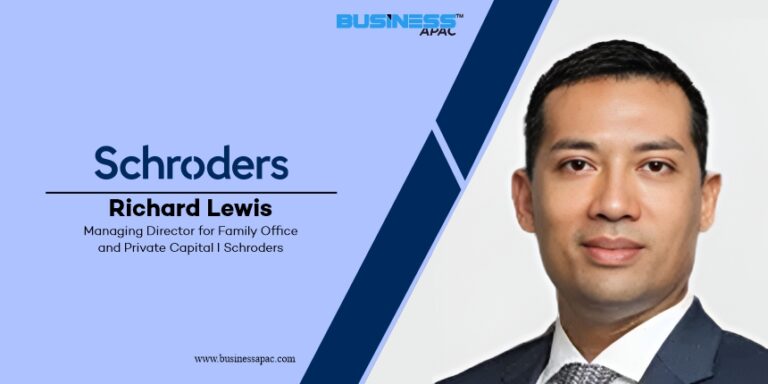
There is a version of the wealth management industry that operates almost entirely in numbers. In basis points and return profiles, in allocation tables, and in quarterly performance reviews. It is a world of precision and measurement, of benchmarks and risk-adjusted outcomes. It is not a dishonest world. But it is, in the view of some of its most thoughtful practitioners, an incomplete one.
Richard Lewis works in the fuller version of that world.
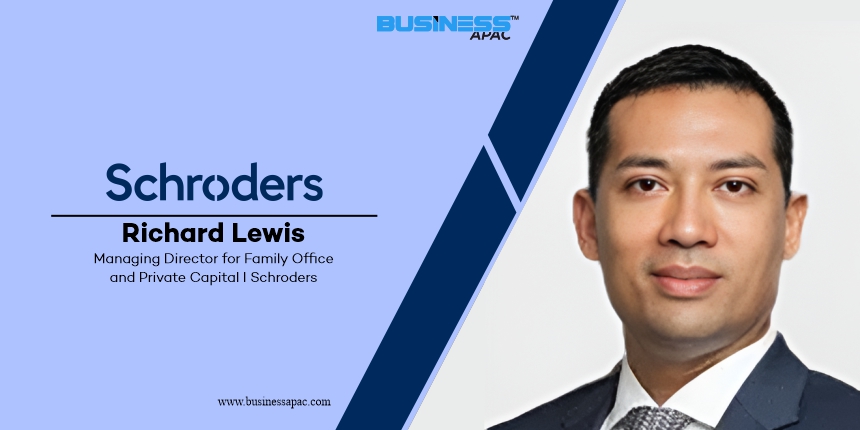
As Managing Director for Family Office and Private Capital at Schroders across Asia-Pacific, one of the world’s most storied and respected asset management institutions, Richard occupies a position that demands both technical command and something less easily quantified: the capacity to understand what wealth is actually for, and to help the families and institutions entrusting it to his guidance build the structures and governance frameworks that allow it to endure.
His professional philosophy makes this orientation explicit. “Enduring wealth,” he has said, “is sustained not by cycles, but by alignment: of capital, governance, purpose, and the human trust that binds them.” It is the kind of statement that a lesser professional might offer as decoration. In Richard’s case, it functions as a blueprint.
The Scope of the Work
To understand what Richard does, it helps to first appreciate the breadth of what his role actually encompasses.
He advises families and institutional partners across Asia on three interconnected and demanding disciplines: the governance of wealth, the structuring of capital, and the long-term stewardship of both. These are not three separate tasks that happen to share a calendar. They are interlocking responsibilities, and the coherence between them is precisely what separates family office advisory done well from family office advisory done adequately.
His work spans family-office design, a discipline that requires understanding not only the technical and jurisdictional considerations of how a family office is constituted, but the human and relational dynamics that will determine whether it actually functions as intended over time.
It spans investment governance, the rigorous work of establishing the decision-making frameworks, oversight mechanisms, and institutional disciplines that allow a family’s investment program to remain coherent and accountable across market cycles and generational transitions.
And it spans institutional platform building, the construction of the infrastructural and operational foundations that allow family offices and their institutional partners to function with the reliability and sophistication that complex, cross-border capital demands.
“Taken together, this is a mandate of considerable scope and consequence.”
Public and Private, Local and Cross-Border
One of the defining features of Richard’s practice is that it refuses easy categorization.
His work spans public and private markets, which is itself a significant distinction. Many advisors operate predominantly within one domain or the other. Public markets demand one kind of governance and analytical discipline; private markets demand another. The capacity to work fluently across both to design investment governance frameworks and family office structures that account for the different liquidity profiles, risk considerations, and decision-making timelines involved is a skill set that takes time and genuine breadth of experience to develop.
His work also spans local and cross-border structures, which introduces the additional layer of jurisdictional complexity that defines so much of contemporary family office advisory in Asia. The region is not a single financial environment. It is a constellation of regulatory regimes, tax frameworks, legal traditions, and cultural attitudes toward wealth and governance, all existing in close proximity and frequent interaction.
To advise families and institutional partners effectively across that landscape requires not only technical knowledge of individual jurisdictions, but the cross-border fluency to understand how they interact, where they create opportunity, and where they introduce risk.
Richard’s practice engages with all of it, including the strategic partnerships that allow family offices and their institutional counterparts to build the capabilities and connections that no single structure or platform can provide alone.
On Governance: The Invisible Infrastructure of Enduring Wealth
If there is a thread that runs through everything Richard does, it is governance.
Governance is, in the context of family wealth, one of the most consequential and least romanticized disciplines in the industry. It is not the part of the story that generates headlines. It does not produce the kind of dramatic return narratives that attract attention. It is, instead, the invisible infrastructure upon which everything else depends.
A family office without sound governance is a structure waiting to encounter the conditions it was not built to withstand. A well-designed investment mandate, without the governance mechanisms to enforce it through periods of market stress or internal disagreement, is an aspiration rather than a plan. The succession of a family’s wealth, without the governance frameworks that give each generation clarity about roles, responsibilities, and decision-making authority, is among the most reliably contentious transitions in private capital.
Richard understands this not as theory, but as the practical reality of what the families and institutional partners he works with are navigating. His focus on governance is, at its core, a recognition that the technical and the human are never truly separate in this work.
Capital and governance must be aligned. Purpose must be articulated and embedded into the structures that are meant to serve it. And the human trust that binds families, institutions, and their advisors together must be earned, tended to, and never taken for granted.
Stewardship as a Discipline
The word that perhaps best captures Richard’s orientation toward his work is one that he uses deliberately: stewardship.
Stewardship implies a relationship to wealth that is different from ownership in an important way. The steward does not simply possess. The steward is responsible for preserving, protecting, and, where possible, enhancing something that has value beyond the present moment, something that is meant to be handed forward.
In the context of family wealth, that temporal dimension is everything. The decisions made today about structure, governance, investment mandate, and institutional partnership will carry consequences that extend well beyond the current generation. The family office designed now will be the inheritance of the next generation of the family. The governance framework established today will shape how future members of that family relate to their capital and to each other.
Richard’s work is oriented around that long view. It is built on the understanding that long-term stewardship of capital is not simply a description of investment time horizon. It is a statement about what the work is ultimately for.
The Schroders Platform
Richard carries out this work from within Schroders, an asset management institution with a history stretching back more than two centuries and a global presence that provides the kind of institutional depth and cross-border reach that the most sophisticated family office mandates require.
That platform matters. The quality of a family office advisor’s work is shaped in part by the institutional infrastructure behind them, the research capabilities, the investment expertise across asset classes, and the global network of relationships and market knowledge that an institution like Schroders brings to every engagement.
For Richard, Schroders provides the foundation upon which a practice built around family-office design, investment governance, and institutional platform building can operate at the level that families and institutional partners across Asia-Pacific both need and deserve.
Alignment as the Organizing Principle
Return, for a moment, to the idea at the center of Richard’s professional philosophy.
“Enduring wealth is sustained not by cycles, but by alignment: of capital, governance, purpose, and the human trust that binds them.”
This is not a statement about market timing. It is not a claim about asset allocation or return generation. It is a statement about what actually allows wealth to persist across time, through market cycles, through generational transitions, through the inevitable moments of internal disagreement and external disruption that every family of significant wealth will eventually encounter.
What sustains wealth, in Richard’s view, is the coherence between what a family has, how it is governed, what it is meant to serve, and the trust between the people responsible for all of it.
That is a definition of endurance that reaches well beyond finance. It is, in the truest sense, a human proposition. And it is the proposition that Richard Lewis has built his career and his practice around.
Quotes
“Enduring wealth is sustained not by cycles, but by alignment: of capital, governance, purpose, and the human trust that binds them.”
“My work focuses on family-office design, investment governance, and institutional platform building, spanning public and private markets, local and cross-border structures, and strategic partnerships.”
Also Read: Cross-Border Wealth & Family Office Leadership: Top Global Advisors, 2026