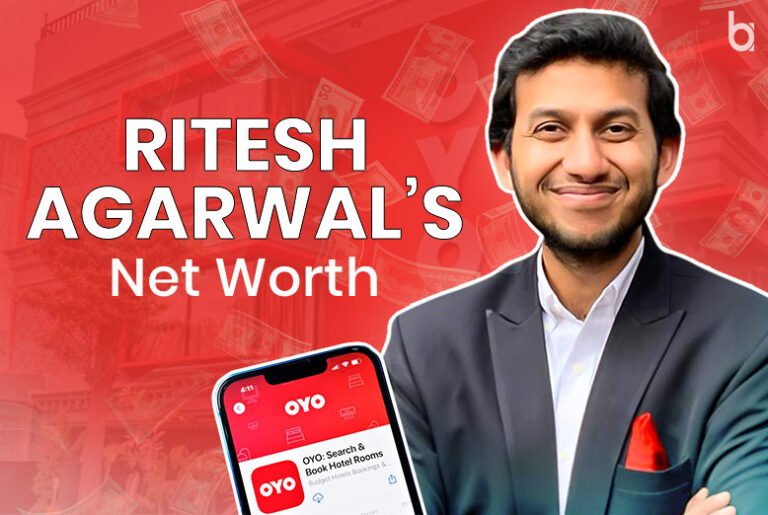
From selling SIM cards in small-town Odisha to commanding boardrooms and television studios, Ritesh Agarwal’s rise is the modern Indian startup myth turned financial fact.
Ritesh Agarwal’s net worth — now estimated at roughly ₹14,400 crore — is not the product of one single IPO or headline. It is the outcome of three moves executed in sequence: early validation (Thiel Fellowship), aggressive capital engineering (the 2019 share buyback financed with debt), and a painful-but-straightforward operational turnaround that delivered OYO’s first-ever PAT in FY24.
Well, below, I unpack the journey, the numbers, and the strategic logic that converted hustle into headline wealth.
Let’s Know Ritesh Agarwal!
| Born | 16 November 1993 |
| Occupation | Entrepreneur, Founder and CEO of PRISM and OYO Rooms |
| Net Worth as of November 2025 | ₹14,400 Cr |
| Spouse | Geetansha Sood (m. 2023) |
| Awards | Thiel Fellowship, Forbes 30 Under 30 Asia |
Now, Let’s Explore Ritesh Agarwal’s Net Worth Journey
1. The start of his Wealth Building
- Early Life & First Hustle: Rayagada to Venture Nursery
It all started in Rayagada, Odisha. Born with a fire in his belly, Ritesh began as a motivated teenager selling SIM cards. That’s pure hustle, isn’t it? It was an early indicator of a founder who learned business by doing, not just reading about it.
By 2011, he launched Oravel Stays (think of it as an Airbnb-like idea for India). He didn’t stop there; the startup was accelerated through Venture Nursery in 2012. This was the first major step on a fast track to professional mentorship and earning that crucial early credibility.
- The Thiel Fellowship: $100k + Validation (2013)
Then came the turning point in 2013. Agarwal became one of the Thiel Fellowship winners and received $100,000. Sure, it was a cash prize, but more importantly, it was a global stamp of validation. This opened doors to connections that helped him recruit talent, attract investors, and reframe Oravel into OYO Rooms. The Thiel Fellowship isn’t just seed capital — it’s social proof that money can’t buy.
- Scale Funding & The $1B Round (2018)
Fast forward to September 2018. OYO had raised major venture capital and was being valued in the unicorn bracket. By this time, the company had already become a headline global startup. Those massive capital rounds built the scale that allowed for the financial engineering that was about to follow.
2. The Masterstroke: The 2019 Share Buyback — Why this made him a billionaire
- The Mechanics (what happened in July 2019)
Here is what he did: In July 2019, Ritesh Agarwal bought back shares worth approximately $2 billion from early investors. This was a massive move that reportedly took his stake from roughly ~10% to ~30–32%. The buyback was financed largely via debt (bank financing and structured financing) and internal arrangements. The scale of the transaction reshaped his ownership math overnight.
- Why this matters (the financial logic)
Let’s look at the leverage on ownership. Before the buyback, Agarwal’s percentage ownership translated to a small personal stake at a high valuation. By using debt to acquire shares from existing investors (who were taking liquidity), he effectively consolidated equity ownership at a moment when valuations were elevated.
This meant any subsequent revaluation of the company (or re-rating via IPO) would multiply his paper wealth many-fold. If OYO’s enterprise value held near the then-$10 billion valuation or rose further, his new ~30% stake (versus ~10%) multiplied his effective claim on that enterprise value. This turned a founder with modest direct wealth into a billionaire on paper. This is the central technical reason Ritesh Agarwal’s net worth later ballooned.
- The Risk (and why it was audacious)
But there was a debt risk. Financing an equity purchase with debt is inherently risky — if the company’s valuation or cash flows falter, the personal guarantees or leverage can create huge downside. Agarwal’s move was a large, concentrated personal bet: he borrowed to buy his own company. That is why many analysts call the July 2019 move the “make-or-break” decision.
3. The Turnaround — From Losses to FY24 Profit
- The Numbers (FY24)
The bet started to pay off. In FY24, OYO reported its first-ever PAT (profit after tax) of ₹229 crore, reversing prior losses. That is super-impressive! Adjusted EBITDA rose 215% to ₹877 crore (from ₹277 crore in FY23). The company recorded eight consecutive quarters of positive adjusted EBITDA — clear evidence that the operating model had stabilized.
- Why does this amplify his net worth?
This led to a value rerating. Private markets — and, importantly, IPO markets — reward sustainable profits and improving margins. The FY24 profitability narrative significantly de-risked OYO’s valuation story. A company that can show positive EBITDA trends and its first PAT becomes investible at higher multiples. With Agarwal’s concentrated stake (grown via the buyback), de-risking translated directly into paper wealth.
4. Shark Tank, PRISM & Portfolio — Visibility + Diversification
- Shark Tank India (Season 3, 2024)
Agarwal joined Shark Tank India Season 3 as the show’s youngest shark, increasing his public profile and deal flow. This media role served two functions: investor deal-sourcing (direct angel/strategic investments) and brand authority for PRISM/OYO.
- PRISM & Rebranding (IPO Preparation)
Notice the change? OYO’s parent entity, Oravel Stays, has been rebranded as PRISM as the company unified its brands and prepared for an IPO. This was a strategic pivot to present a cleaner corporate structure and premiumization strategy to public investors. This corporate refocus matters because public market valuations and IPO timing will be the next key lever for realizing paper gains as cash.
- Investments & Portfolio (what we know)
On-screen and off-screen, Agarwal has invested in startups and sectors tied to travel, hospitality, and the broader consumer stack. Shark Tank appearances expose him to early-stage companies and co-investment opportunities — an ancillary but real channel for wealth accumulation.
5. Assets & Lifestyle — What the Wealth Looks Like (publicly reported)
- Real estate & premium hospitality bets: Through PRISM/OYO rollups (including asset plays such as OYO Assets and premium brands like Townhouse and Sunday), the company controls significant hotel assets and management contracts — indirectly backing Agarwal’s net worth with real assets.
- Public persona & vehicles: Agarwal’s lifestyle is high-profile (media presence, international travel, reported executive perks), but much of the personal asset disclosure is private — typical for founders whose wealth is mostly private equity on paper rather than liquid cash.
(Note: where exact car/house lists are not publicly verified, avoid conjecture.)
6. Why the Numbers Add Up: A Simple Ownership + Profit Rerating Model
- Ownership multiplier (2019): Buyback triples founder stake → founder’s equity becomes 3x larger at the same valuation.
- Valuation de-risking (2024): OYO shows sustained profitability and positive EBITDA trendlines → multiple expansion (private and public markets pay more).
- Corporate restructure (PRISM + IPO path): Clean corporate identity and asset packaging improve investor confidence and make a public listing feasible at a premium.
Together: Ownership × Profitability × IPO realism = Realized or paper net worth in the ₹14,000–₹16,000 Cr band, as reported in recent rich-list coverage.
My Opinion
Ritesh Agarwal’s net worth is the product of timing, audacious leverage, and a disciplined operational turnaround. The 2019 debt-funded buyback was the decisive move that changed the ownership math; FY24’s PAT and rising adjusted EBITDA provided the de-risking needed for a re-rating.
The upcoming IPO under the PRISM identity is the critical event — if markets reward sustainable margins and growth, Agarwal’s paper wealth can convert to realized wealth.
However, the concentrated nature of his holdings and legacy leverage means downside remains if growth stalls or macro liquidity tightens. In short, wealth is big, but not yet fully realized — it depends on execution and public-market appetite.
Here Are Some Life Lessons From Ritesh Agarwal
- Bet on yourself, structurally: The 2019 buyback wasn’t ego — it was a capital structure decision to convert future value into present ownership. (Calculated personal leverage.)
- Validation scales faster than capital: The Thiel Fellowship didn’t just give $100k — it opened networks that multiplied fundraising velocity.
- Turn efficiency into valuation: Eight quarters of positive EBITDA show investors prefer predictable margins over hypergrowth without unit economics.
- Branding before IPO: Rebranding to PRISM is strategic packaging — ready the company to be valued as a portfolio of global hospitality assets rather than a single label.
- Public visibility accelerates deal flow: Media roles (Shark Tank) are not just PR — they’re sourcing channels and soft-power accelerants for future strategic moves.
If this breakdown changed how you see startup wealth creation — share this post with a founder or investor who needs to learn how ownership engineering and operational discipline combine to create billion-rupee outcomes.
FAQs
- What is Ritesh Agarwal’s Net Worth in 2025?
According to The Economic Times and The Indian Express, Ritesh Agarwal’s net worth is ₹14,400 crore as of November 2025, reflecting PRISM/OYO valuation moves and ownership consolidation.
- How did Ritesh Agarwal become a billionaire?
The decisive event was the July 2019 $2 bn share buyback that materially increased his stake (from ~10% to ~30%), combined with later financial performance and re-rating potential ahead of an IPO.
- Did OYO make a profit?
Yes — OYO reported its first-ever PAT of ₹229 crore for FY24, with adjusted EBITDA rising to ₹877 crore, marking eight consecutive quarters of positive adjusted EBITDA.
- What is PRISM and why does it matter?
PRISM is the new corporate identity (formerly Oravel Stays) created to unify OYO’s portfolio and position the company for an IPO — crucial for converting paper value into public-market liquidity.
- Is Ritesh Agarwal on Shark Tank India?
Yes — he joined Shark Tank India Season 3 as the show’s youngest shark, boosting his personal brand and access to early-stage deal flow, alongside other sharks, such as Aman Gupta, Anupam Mittal, Vineeta Singh, Radhika Gupta, Peyush Bansal, and Kunal Bahl.