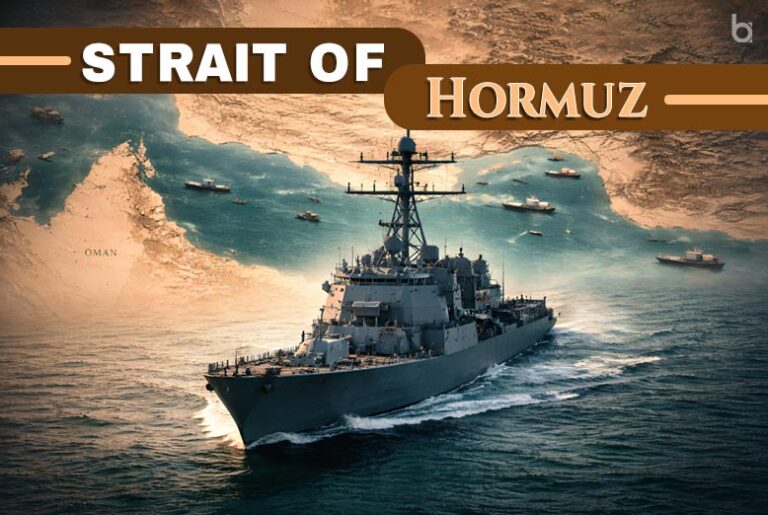
A narrow waterway quietly controls the rhythm of the global economy. The Strait of Hormuz connects the Persian Gulf to the Gulf of Oman and serves as a lifeline for energy flows.
Nearly 19.87 million barrels of oil passed through the Strait in 2025, which shows its unmatched scale. The Strait of Hormuz stands at the center of global energy security, trade stability, and geopolitical tension.
This blog explains its geography, economic power, and political risks in simple terms. It also explores what happens if disruption occurs and why the world watches it closely. To understand its influence, one must first explore its physical structure and location.
What is the Strait of Hormuz and Why is it Important
The Strait of Hormuz is a narrow natural passage that connects the Persian Gulf to the Gulf of Oman. It acts as a gateway between oil-producing nations and global markets. The Strait of Hormuz supports a major share of the Persian Gulf trade route, which powers global commerce.
The Strait of Hormuz lies between Iran to the north and Oman to the south. This location gives it exceptional geopolitical importance. The Strait of Hormuz meaning becomes clearer when one sees it as a strategic bridge between supply and demand.
The Strait of Hormuz plays a key role in Middle East oil transport. Tankers carry crude oil and refined products through this passage daily. Therefore, the Strait of Hormuz directly influences the global oil supply chain.
The Strait of Hormuz map shows a narrow waterway with structured shipping lanes. These lanes help manage heavy traffic safely. However, the Strait of Hormuz also becomes vulnerable due to its narrow width.
Because no alternative route can fully replace it, the Strait of Hormuz remains critical. Pipelines exist, but they cannot match its capacity. Therefore, the Strait of Hormuz continues to dominate global maritime trade routes.
The importance of the Strait of Hormuz also lies in its ability to connect continents. Asia, Europe, and parts of Africa rely on this route. As a result, the Strait of Hormuz becomes essential for global energy security.
Geography and Navigation: Mapping the Bottleneck
The Strait of Hormuz is about 21 miles wide at its narrowest point. However, ships do not use the entire width for navigation. Instead, they follow a structured Traffic Separation Scheme.
The Strait of Hormuz uses two-mile-wide lanes for incoming and outgoing vessels. A buffer zone separates these lanes to reduce collision risks. Therefore, the Strait of Hormuz maintains safety despite heavy traffic.
Iran controls the northern coastline, while Oman controls the southern coastline. This shared control creates a delicate balance of power. However, the Strait of Hormuz also becomes a sensitive geopolitical space.
The Strait of Hormuz map reveals how ships must follow fixed routes. These routes make movement predictable. As a result, the Strait of Hormuz becomes easier to monitor but also more vulnerable.
The Strait of Hormuz handles some of the largest oil tankers in the world. These vessels require precise navigation. Therefore, the Strait of Hormuz functions like a highly controlled system.
Because of its narrow structure, the Strait of Hormuz acts as a bottleneck. This bottleneck limits the speed and volume of maritime movement. Consequently, the Strait of Hormuz directly impacts global maritime trade routes.
The geography of the Strait of Hormuz also affects military strategy. Narrow lanes allow for easier monitoring and potential control. Therefore, the Strait of Hormuz holds both economic and strategic value.
The Economic Engine: Oil, LNG, and Global Trade
The Strait of Hormuz serves as a central artery in the global oil supply chain. It handles around one-quarter of global seaborne oil trade. This makes the Strait of Hormuz one of the most critical maritime trade routes.
The Strait of Hormuz supports Middle East oil transport from major producers such as Saudi Arabia, Iraq, Kuwait, and the UAE. These nations depend heavily on this route for exports. Therefore, the Strait of Hormuz connects energy-rich regions with consumption hubs.
Countries like China, India, and Japan rely significantly on these imports. The Strait of Hormuz ensures a steady energy supply for their industries. Without the Strait of Hormuz, economic stability in these regions would face severe challenges.
The Strait of Hormuz also plays a vital role in liquefied natural gas transport. Qatar uses this route as its primary export channel. Therefore, the Strait of Hormuz strengthens its role in global energy security.
The concentration of trade through the Strait of Hormuz creates price sensitivity. Even minor disruptions can trigger global oil price fluctuations. As a result, the Strait of Hormuz acts as an economic pressure point.
The Strait of Hormuz remains unmatched in capacity and efficiency. While pipelines offer alternatives, they cannot handle similar volumes. Therefore, the Strait of Hormuz continues to dominate the global oil supply chain.
Geopolitics and Security: The Chessboard of the Middle East
The Strait of Hormuz sits at the center of geopolitical tension ( Israel and Iran war ) in the Middle East. Iran holds a strategic advantage due to its geographic position. The Strait of Hormuz gives Iran the ability to influence global energy flows and regional stability.
Iran has developed Anti-Access and Area Denial capabilities to strengthen its position. These include missiles, fast attack boats, drones, and naval mines. Therefore, the Strait of Hormuz becomes a key zone for military signaling and deterrence.
The United States maintains a strong naval presence through its Fifth Fleet. This fleet operates to ensure safe navigation and protect commercial vessels. As a result, the Strait of Hormuz remains under continuous monitoring by global powers.
The Strait of Hormuz carries nearly 20 percent of the world’s total oil supply. This makes it a critical asset during times of conflict. Therefore, any tension in the Strait of Hormuz quickly affects global markets and political decisions.
Historically, the Tanker Wars during the 1980s showed how vulnerable shipping can be. Today, threats have evolved into drone surveillance, cyber risks, and precision strikes. As a result, the Strait of Hormuz continues to face modern security challenges.
The Strait of Hormuz also shapes diplomatic relations across nations. Countries build alliances and defense strategies around its stability. Therefore, the Strait of Hormuz acts not just as a trade route but as a geopolitical pressure point.
Because of its importance, even minor incidents receive global attention. The Strait of Hormuz remains a constant factor in global security planning and energy policy decisions.
Risk Analysis: Can the Strait of Hormuz Be Closed
The question of closure remains one of the most critical concerns for global markets. The Strait of Hormuz can face disruption through naval blockades, mines, or missile attacks. However, a complete shutdown remains difficult due to international response and military presence.
China and India received 44 percent of crude oil flowing through the Strait in 2025. This shows how deeply major economies depend on the Strait of Hormuz. Therefore, any disruption would create immediate pressure on energy prices and supply chains.
Only 3.5 to 5.5 million barrels per day can bypass the Strait through alternative pipelines. This limited capacity highlights a major structural weakness. As a result, the Strait of Hormuz remains essential for global energy movement.
International maritime law supports free transit through such waterways. Ships have the legal right to pass without obstruction. However, enforcement depends on naval strength and geopolitical balance.
The Strait of Hormuz also influences markets through perception. Even the threat of disruption can increase oil prices rapidly. Therefore, the Strait of Hormuz acts as both a physical and psychological risk factor.
Short-term disruptions may occur through targeted attacks or regional tensions. However, long-term closure would require sustained conflict, which remains unlikely. As a result, the Strait of Hormuz continues to operate despite periodic risks.
The Strait of Hormuz remains central to global risk assessment. Governments, investors, and energy companies monitor it closely. Therefore, the Strait of Hormuz continues to shape global economic and strategic decisions.
Advanced Chokepoint Analysis: The 2026 Energy Outlook
The Strait of Hormuz represents a classic maritime chokepoint. A chokepoint controls the movement of goods through a narrow passage. The Strait of Hormuz fits this definition perfectly.
Global maritime trade routes depend on such chokepoints for efficiency. The Strait of Hormuz connects major oil producers with global consumers. Therefore, the Strait of Hormuz ensures smooth energy distribution.
However, this efficiency creates concentrated risk. A single disruption can affect multiple economies simultaneously. As a result, the Strait of Hormuz becomes a strategic vulnerability.
Energy transition trends may change future demand patterns. Renewable energy and green hydrogen may reduce reliance on oil. However, the Strait of Hormuz will wremain relevant for decades.
The Strait of Hormuz continues to support global energy security. Emerging trade routes may ease some pressure. However, none can fully replace the Strait of Hormuz.
Because of this, policymakers treat the Strait of Hormuz as a strategic priority. It acts as a barometer of global stability. Therefore, the Strait of Hormuz remains central to long-term planning.
Comparison Snapshot
| Choke point | Key Role | Risk Level |
| Hormuz | Oil transport | Very high |
| Suez | Trade shortcut | High |
| Malacca | Asia trade route | High |
End Note
The Strait of Hormuz stands as a defining feature of modern global systems. It combines geography, economics, and geopolitics into a single strategic point. The Strait of Hormuz continues to shape oil supply chains, influence global energy security, and guide policy decisions. Its narrow structure creates both efficiency and vulnerability.
While future energy transitions may reduce dependence, no immediate alternative exists. Therefore, the Strait of Hormuz remains a vital pillar of maritime trade routes and global stability. Control over such narrow passages continues to influence the balance of global power.
FAQ’s
Why is the Strait of Hormuz considered a global chokepoint?
It is extremely narrow, yet it carries a massive share of global oil shipments. This combination gives it the power to influence global trade and energy prices.
Is it realistically possible to close the Strait of Hormuz?
Temporary disruptions can occur through military or political actions. However, a complete and long-term closure remains highly difficult to sustain.
Who actually controls the Strait of Hormuz today?
Iran and Oman border and control its territorial waters on either side. At the same time, international naval forces actively monitor and secure the route.
What is the exact width of the Strait of Hormuz at its narrowest point?
The strait is about 21 miles wide at its narrowest section. However, usable shipping lanes are much narrower due to regulated traffic routes.
Which countries geographically border the Strait of Hormuz?
Iran lies along the northern coastline of the strait. Oman, through its Musandam Peninsula, forms the southern boundary.
Tejas Tahmankar