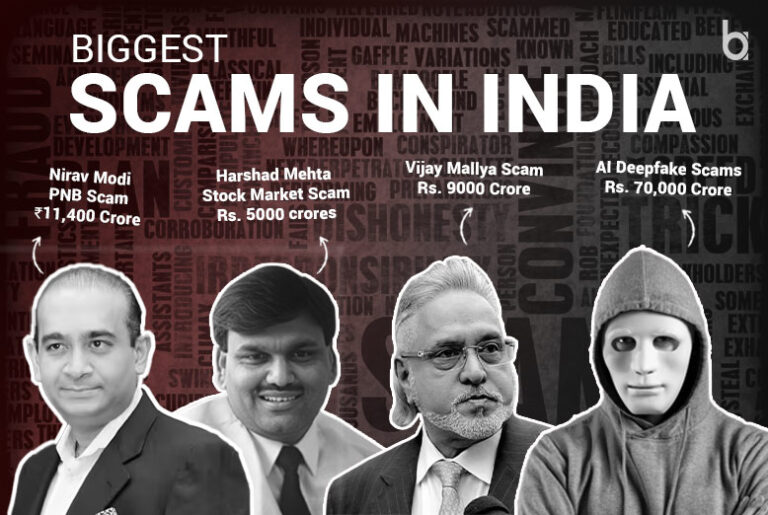
India loses an estimated ₹1.5 lakh crore to financial fraud every year — and the number is accelerating. In 2026 alone, cyber fraud cases surged 25% year-on-year, with scammers weaponising artificial intelligence, the UPI payment network, and social media to reach ordinary citizens at unprecedented scale.
This list ranks the 10 Biggest Scams in India by a combination of total financial loss, 2026 relevance, and public danger. Each entry includes an explanation of the fraud mechanism, a real-world case, and concrete steps you can take right now to protect yourself or your business.
Let’s look at some of the biggest scams in India.
1. 2G Spectrum Scam: Rs. 1,76,000 crores

Fraud Type:
Regulatory Corruption (Public officials manipulate legal processes to benefit private interests at the expense of the national treasury.)
In 2008, Telecom Minister A. Raja allocated 2G spectrum licenses on a first-come-first-serve basis instead of auctions, undercharging companies like Unitech Wireless. The Comptroller and Auditor General (CAG) calculated a ₹1.76 lakh crore loss, making it the biggest scam in Indian history. In February 2012, the Supreme Court canceled 122 licenses, calling the process “unconstitutional”. But in Dec 2017, A. Raja was acquitted due to a lack of evidence. And as od 2026, TRAI is still recovering dues.
2026 Lesson:
If an investment promises a ‘government-allocated’ return with no risk, it is a scam. No Indian regulatory body offers guaranteed investment returns.
2. Digital Arrest Scam: ₹3,000 Cr+ (2026)
Fraud Type:
AI Deepfake + Impersonation Fraud (Scammers use AI-generated visuals and fake government credentials to simulate an official arrest process, coercing victims into paying to ‘clear their name’.)
In January 2026, a retired IIT professor and his wife, both respected professionals in their 70s, lost ₹14 crore to callers posing as Narcotics Control Bureau officers on a WhatsApp video call. The fraudsters wore digitally deepfaked NCB uniforms, displayed what appeared to be a Supreme Court arrest warrant on screen, and kept the couple on a continuous 11-day ‘supervised call’, isolating them from family contact until the money was transferred. This tactic, known as a ‘digital arrest,’ has become India’s fastest-growing cybercrime, with over 15,000 cases recorded every month in 2026. In Q1 2026, the NCRB logs 45,000+ digital arrest complaints; ₹3,000 Cr total losses confirmed.
2026 Lesson:
- No legitimate law enforcement agency in India, like the CBI, NCB, ED, or police, will ever detain you digitally over a video call, demand UPI payment to avoid arrest, or prevent you from speaking to a lawyer or family member.
- If you are unsure whether a caller is a real officer, tell them you will call back on the official number listed on the agency’s website, real officers will wait.
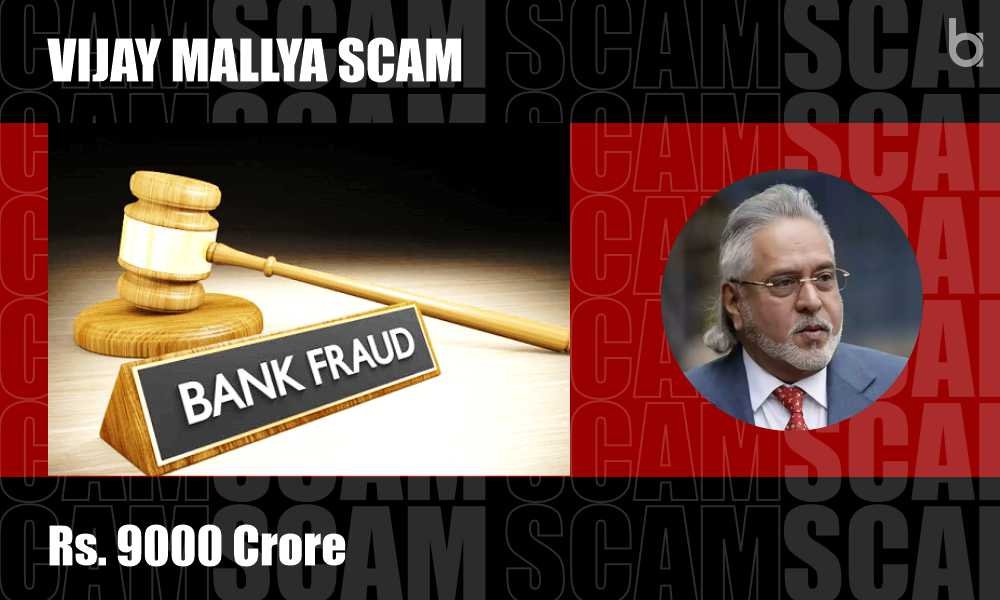
3. Vijay Mallya Scam – Rs. 9000 Crore
Fraud Type:
Wilful Bank Loan Default (A corporate borrower takes large loans using inflated asset valuations and then flees the jurisdiction before repayment, leaving state-backed banks and ultimately taxpayers, thus absorbing the losses.)
The Vijay Mallya scam is one of the biggest bank scams in India. Vijay Mallya took over ₹9,000 crore in loans from 17 banks, including State Bank of India and Punjab National Bank, between 2005 and 2012 to run Kingfisher Airlines, largely against projected revenues. The airline collapsed in 2012 with ₹9,000 crore in defaults, after which Mallya left India in 2016. Following a 2019 UK extradition ruling and a 2023 “fugitive economic offender” tag, India secured rights in April 2026 to seize his UK assets, though full recovery of dues remains incomplete.
2026 Lesson:
- Mallya’s case established the Fugitive Economic Offenders Act (2018), which now allows Indian courts to seize assets of loan defaulters who flee abroad — a significant deterrent, though recovery is rarely complete.
- Check a company’s loan and litigation history on the MCA21 portal (mca.gov.in) before signing any financial agreement.
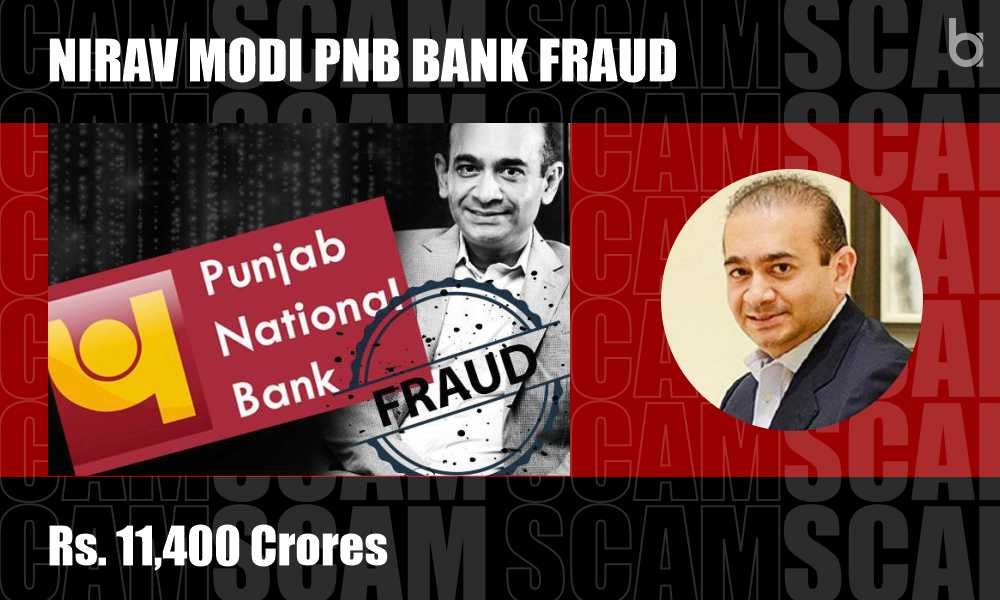
4. Nirav Modi PNB Scam: ₹11,400 Crore
Fraud Type:
Banking Instrument Forgery (Fraudulent letters of credit and guarantees are issued by corrupt bank insiders, allowing borrowers to access international loans that the bank and taxpayers ultimately must repay)
Nirav Modi and his uncle Mehul Choksi orchestrated a ₹11,400 crore fraud between 2011 and 2018 using fraudulent Letters of Undertaking (LoUs) issued via two corrupt officials at Punjab National Bank’s Brady House branch. These LoUs enabled unsecured overseas borrowing without being recorded in the bank’s core system. The scam surfaced in January 2018 when PNB filed a complaint with the CBI, after which Modi fled to London. Arrested in 2018, his extradition was approved in 2021, but as of March 2026, he remains in UK custody contesting extradition, while PNB has recovered around ₹2,500 crore through asset sales so far.
2026 Lesson:
In 2026, the same insider threat manifests differently: rogue employees at banks, telecom companies, and digital payment platforms are being recruited by fraud syndicates to sell customer KYC data, account details, and OTPs.
The Nirav Modi scandal, one of the biggest scams in India, was only possible because two insiders actively collaborated with the fraudster.
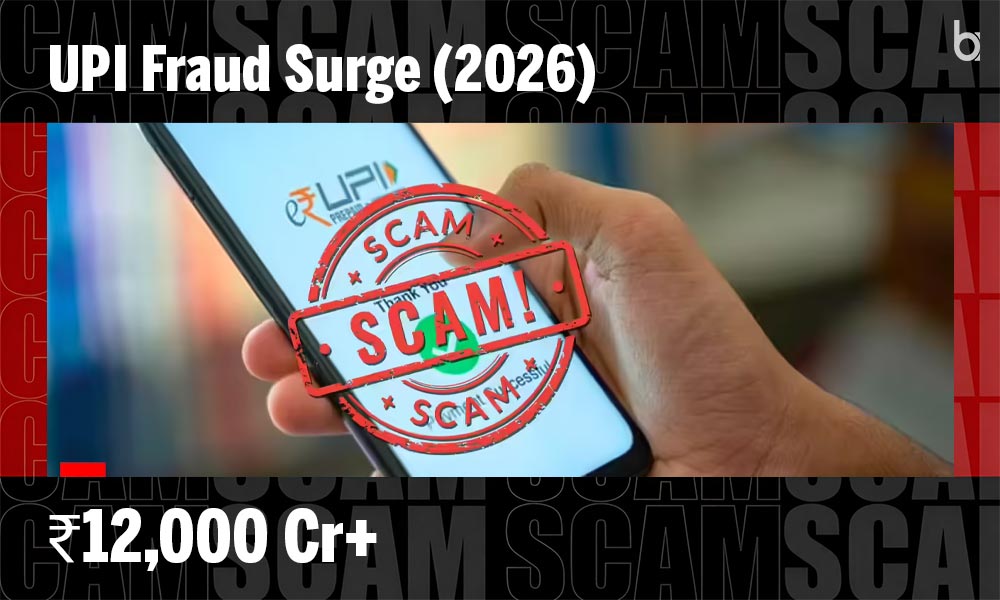
5. UPI Fraud Surge: ₹12,000 Cr+ (2026)
Fraud Type:
Social Engineering + Payment Spoofing (Scammers exploit users’ unfamiliarity with UPI mechanics, tricking users into approving payments they believe are incoming.)
India’s UPI network processes 17+ billion transactions monthly, with fraud scaling alongside it. Data from the Reserve Bank of India shows 1.6 million UPI fraud cases in FY2025–26, causing losses of ₹12,000+ crore, an 8,600% rise since 2019. The most common tactic is a fake “collect request,” where victims expecting money approve a request and unknowingly send funds—such as an OLX seller losing ₹45,000 in a single transaction.
2026 Lesson:
The cardinal rule: you never need to enter your PIN or approve a request to receive money. If any action is required on your end to ‘receive’ a payment, it is fraud.
UPI’s simplicity is both its strength and its greatest vulnerability. Scammers rely on speed and confusion — the victim has seconds to read a screen before approving.
Enable biometric authentication on your UPI app and set a daily transaction limit of ₹5,000 for unknown contacts.
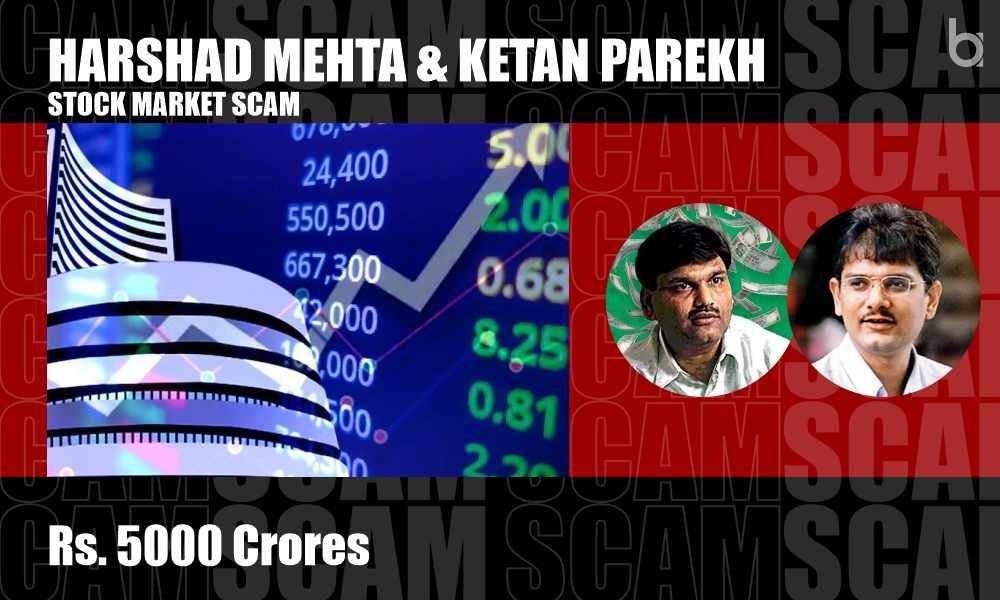
6. Harshad Mehta & Ketan Parekh Stock Market Scam – Rs. 5000 crores
Fraud Type:
Market Manipulation via Fake Bank Receipts (Diverting bank funds into stocks to inflate prices before collapse.)
The Harshad Mehta scam is one of the the biggest scams in India. Harshad Mehta exploited inter-bank settlement gaps in the early 1990s, using fake Bank Receipts to access large funds and pump select stocks. When the scam collapsed in 1992, the Sensex fell nearly 40%, wiping out retail investors and prompting stronger powers for Securities and Exchange Board of India. Ketan Parekh used a similar strategy (1999–2001), leveraging circular trading and a ₹900 crore bank loan to inflate tech stocks before the crash.
2026 Lesson
If a stock is recommended heavily in a chat group you recently joined and then starts rising quickly, you may be watching a pump-and-dump scheme unfold. Exit before the promoters do.
Before investing in any stock tip group on Telegram, WhatsApp, or YouTube, check the SEBI registration of the ‘advisor’ at sebi.gov.in.
7. Coalgate Scam: ₹1.86 Lakh Crore

Fraud Type:
Regulatory Corruption + Resource Misallocation (Government officials allocate public resources allocated without competitive bidding, enabling windfall gains.)
The coal allocation scam, sometimes known as “Coalgate,” is a political scandal that began in 2012, when the United Progressive Alliance (UPA) was in power. Between 2004 and 2009, the UPA government allocated 194 coal blocks to private and public companies through an opaque screening committee process instead of competitive auctions. The Comptroller and Auditor General’s 2012 report concluded that the allocation caused a notional loss of ₹1.86 lakh crore to the exchequer, because the blocks were handed over at prices far below what an open auction would have yielded. The scandal triggered criminal investigations against several politicians, industrialists, and bureaucrats, though most cases were mired in legal delays. In 2014, the Supreme Court cancelled 214 coal block allocations, calling the process ‘arbitrary and illegal.’
2026 Lesson:
If you are approached to ‘invest’ in a natural resource project with guaranteed government backing, verify the project registration on the relevant ministry’s portal before committing any funds.
8. AI Deepfake Scams: ₹70,000 Cr (2026)
Fraud Type:
AI Deepfake + Voice Cloning (Using realistic fake video/audio to impersonate trusted individuals and trigger payments.)
Deepfake fraud incidents in India surged 550% between 2023 and 2026. In one widely reported case in Indore, a family received a video call showing their son apparently held captive, hands tied, visibly distressed, and paid ₹1.02 lakh before a separate call confirmed their son was safe at work. The video had been generated from publicly available social media clips using consumer-grade AI tools. At the corporate level, finance teams have wired funds to fraudsters who impersonated CFOs on video calls. The technology requires as little as 30 seconds of audio to clone a voice convincingly.
2026 Lesson:
Use Truecaller’s deepfake call detection feature (available on Android and iOS from 2025) to flag AI-generated voice calls automatically.
Set a family code word right now — a phrase only your immediate family knows. In any distress call, ask for it. A deepfake cannot know it.
9. Commonwealth Games Scam: ₹70,000 Crore

Fraud Type:
Public Procurement Fraud (Public procurement fraud—government contracts awarded at inflated prices to connected entities, with poor-quality delivery.)
The 2010 Commonwealth Games in Delhi were marred by widespread allegations of corruption, with organizing committee chief Suresh Kalmadi accused of irregularities in contract awards. Estimated losses of around ₹70,000 crore stemmed from inflated tenders, mismanagement, and substandard infrastructure, with reports of athletes housed in poor conditions despite massive spending.
2026 Lesson:
Similar concerns apply today to fast-tracked government tech and smart city projects. Investors should verify contracts through official portals like GeM and rely on audited financials rather than headline deal values.
This case highlights risks when large public contracts lack real-time oversight.
10. Mule Networks: ₹1.5 Lakh Cr (2026)
Fraud Type:
Money Mule Network (Fraudsters recruit ordinary people to receive stolen funds in their personal bank accounts and forward them on, making the money trail nearly impossible for law enforcement to follow.)
Mule networks are the backbone of modern cyber fraud, routing stolen money through multiple accounts to hide its origin. Large losses like ₹14 crore scams or smaller UPI frauds are split and passed through dozens of mule accounts to evade detection. The Reserve Bank of India flagged 1.1 lakh such accounts in 2022, while the Indian Cyber Crime Coordination Centre identified 4,000+ networks by 2024. By 2025, losses hit ₹1.5 lakh crore (up 25% YoY), with 35,000+ arrests in Q1 2026, as banks like State Bank of India and HDFC Bank deploy AI tracking.
2026 Lesson:
- “Part-time payment” or “account handling” jobs offering commissions are typical mule recruitment traps.
- Never share bank or UPI access; if you receive unexplained funds, freeze your account immediately and report it via the national cybercrime portal or helpline 1930.
End Note
The Biggest Scams in India spans six decades and two very different worlds:
- The institutional corruption of 2G, Coalgate, and Commonwealth Games, where the perpetrators wore suits and held government offices
- The hyper-personal digital frauds of 2026, where scammers reach into your pocket through your smartphone screen.
The connective tissue between all ten entries is the same: scammers exploit trust, urgency, and information asymmetry. Therefore, Awareness is the primary defence.
And since India ranks #2 globally as a scam target — cybersecurity investment is no longer optional.
If this list on the Biggest Scams in India helped you understand these frauds beyond just the headline numbers, share it with your network — someone else might avoid becoming the next victim.
Also Read:- Top 10 Cybersecurity Companies in India [2026 Update]