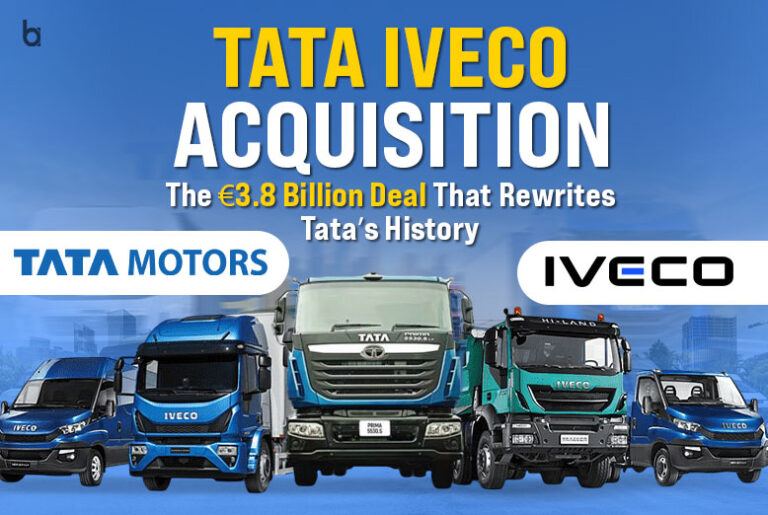
Tata Motors has completed a €3.8 billion ($4.36 billion) agreement to acquire the Iveco Group, placing India’s largest commercial vehicle maker directly into Europe’s premium truck and bus segments.
The deal creates a combined business with €22 billion in annual revenue and strong base markets in India and Italy. Tata brings cost-efficient manufacturing, while Iveco adds established European brands and advanced zero-emission vehicle technology.
Commenting on the acquisition, Tata Motors Chairman Natarajan Chandrasekaran said, “This follows the demerger of our Commercial Vehicle business. The combined group will compete globally with strategic home markets in India and Europe.”
Furthermore, Iveco Group CEO Olof Persson stated, “The partnership strengthens industrial capabilities, accelerates zero-emission innovation, and expands presence in key global markets.”
This Tata Iveco Acquisition 2026 marks Tata Group’s second-largest overseas acquisition after the 2007 Corus deal.
Tata Iveco Acquisition 2026 Deal Details
1. Transaction Structure and Valuation
Tata Motors will acquire all Iveco Group common shares, excluding the defense division, through an all-cash tender offer priced at €14.1 per share. The total transaction value stands at approximately ₹38,098 crore ($4.36 billion).
2. Timeline and Closing Conditions
The deal was announced on July 30, 2025, and is expected to close by April 2026. Completion of the Acquisition depends on regulatory approvals and the completion of key pre-closing steps outlined in the agreement.
3. Defense Business Separation
As part of the transaction structure, Iveco must first separate its defense business and sell it to Italy’s Leonardo S.p.A. for €1.7 billion. This divestment must be completed by March 31, 2026, before the main acquisition can be finalized.
4. Regulatory and Shareholder Approvals
The Italian government approved the Tata Iveco Acquisition 2026 on October 31, 2025, under its Golden Power framework. Final completion remains subject to EU merger clearance and foreign investment approvals.
Iveco’s largest shareholder, Exor N.V., which holds 27.1% of the company, has formally committed to tender its shares into the offer.
5. Deal Significance and Financing
The transaction marks Tata Group’s second-largest overseas acquisition, after the €9.23 billion Corus deal in 2007, and is the largest acquisition in Tata Motors’ history.
To fund the Acquisition, Tata Motors has secured a $4.5 billion bridge loan with a 12-month tenure. The company plans to refinance this borrowing through a mix of equity and long-term debt within 12 to 18 months.
6. Market Context: Commercial Vehicle Consolidation Accelerates
The €3.8 billion Tata-Iveco deal reflects ongoing consolidation in global commercial vehicles as manufacturers scale for electrification and regulatory compliance.
Tata strengthens its position against Daimler Truck, Volvo Group, and PACCAR while gaining technology for Euro 7 emissions and beyond.
Strategic Impact: Dual Home Markets in India and Europe
The Tata Iveco Acquisition 2026 establishes a rare “dual home market” model, with India and Europe acting as equal strategic anchors rather than a single dominant base. This structure allows the combined group to balance volume-driven growth with technology-led premium manufacturing.
Revenue Breakdown of the Combined Entity
| Region | Revenue Share | Units | Key Markets |
| Europe | 50% (€11B) | 270K | Italy, Germany, France, UK |
| India | 35% (€7.7B) | 200K | Domestic + exports |
| Americas | 15% (€3.3B) | 70K | US, Latin America |
Europe contributes half of group revenue, driven by premium trucks, buses, and stricter emissions-led pricing, while India delivers scale, cost efficiency, and faster demand growth. This split reduces dependence on any single market cycle and strengthens resilience across economic and regulatory shifts.
Operationally, Iveco will continue to operate from its Turin headquarters, with its brands and European manufacturing facilities remaining intact. After delisting from Euronext Milan, Iveco will function as a wholly owned Tata Motors subsidiary.
Competitive Advantages: What IVECO Brings to Tata Motors
- Seven-Brand Portfolio: Trucks, buses, powertrains (FPT Industrial), specialty vehicles, and financial services.
- Proven Powertrain Technology: Advanced diesel, gas, electric, and hydrogen platforms ready for Euro 7.
- Electrification Capabilities: Battery-electric and fuel-cell commercial vehicles are already in deployment.
- European R&D Infrastructure: Dedicated product development and prototype centers in Europe.
- Manufacturing Depth: Established plants and supplier ecosystems across key European markets.
- Platform Scalability: Vehicle architectures adaptable across regions and regulatory regimes.
End Note
The Tata Iveco Acquisition 2026 establishes a strong foundation for a globally competitive commercial vehicle business.
By integrating operations across India and Europe, the combined group is positioned to respond effectively to shifting market demands, regulatory changes, and technological advancements.
The acquisition strengthens Tata Motors’ ability to scale innovation, advance zero-emission solutions, and optimize manufacturing and supply chains across regions.
With balanced exposure to mature European markets and high-growth Indian demand, the Acquisition lays the groundwork for sustainable growth, resilience, and long-term value creation in the global commercial vehicle industry.
FAQs
- When will Tata Motors complete the Iveco acquisition?
Expected by April 2026, pending Iveco’s defense business sale to Leonardo (€1.7B) by March 31, 2026, and final regulatory approvals. Italian Golden Power clearance received October 31, 2025.
- What does Tata Motors gain from buying Iveco?
€22B combined revenue, 540K unit sales, 50% Europe market access, 7 brands (Iveco Bus, FPT Industrial), zero-emission truck tech, and manufacturing in Italy/Germany/France.
- How does Tata fund the €3.8 billion Iveco deal?
$4.5B bridge loan (12 months), to be refinanced via equity + long-term debt within 12-18 months. Tata’s second-largest acquisition after the 2007 Corus deal.