Healthcare does not stand still. It shifts with every new discovery, every emerging technology, and every family that walks into a hospital looking for answers. Some physicians spend their careers mastering the bedside. Others begin there and feel called to build something larger.
Dr. Sally Aboelesaad, the Founder and CEO of Smart Learning Academy and the Smart Institute of Health Innovation (SIHI), began in the most delicate corner of medicine. As a neonatal physician, she worked in NICUs, caring for critically ill newborns while guiding anxious families through fragile moments. She later stepped into pediatric emergency medicine, where fast decisions often meant the difference between crisis and recovery. Over more than fifteen years in Egypt and Saudi Arabia, she sharpened her clinical judgment and developed a steady leadership style under pressure.
Her responsibilities expanded when she became Medical Director at Tanta Al-Khair, overseeing operations and quality initiatives. “I realized that real impact in healthcare requires more than clinical skill,” she says. That insight led her to pursue an MBA in Hospital Management, a DBA in Digital Transformation, and executive programs in AI in healthcare and leadership at Harvard Medical School and Stanford University.
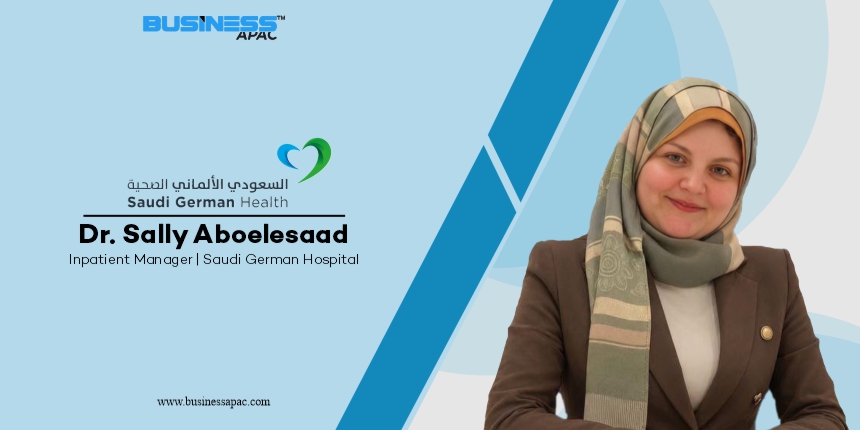
Currently serving as Inpatient Manager at the Saudi German Hospital, Jeddah Branch, Dr. Aboelesaad leads the strategic and operational management of all inpatient services. Her primary focus centers on ensuring excellence in patient flow, capacity optimization, and seamless healthcare delivery. She actively drives multidisciplinary collaboration to optimize patient outcomes, reduce Length of Stay (LOS), enhance bed utilization, and elevate operational efficiency across the hospital. By overseeing discharge management, patient access, resource allocation, and executive performance reporting, she champions quality improvement initiatives that support organizational excellence, patient safety, and sustainable healthcare performance.
Today, alongside her executive hospital management role, she connects frontline care with digital innovation through Smart Learning Academy and SIHI, preparing professionals and families for a rapidly changing healthcare landscape.
A Shared Vision across Two Platforms
On paper, Smart Learning Academy and the Smart Institute of Health Innovation operate in different spaces. One works with children. The other partners with healthcare institutions. Under Dr. Aboelesaad’s leadership, however, both follow a single strategic direction.
She built both ventures around one idea: learning must prepare people for a future shaped by technology. Smart Learning Academy focuses on young minds. It introduces children to critical thinking, digital literacy, ethical decision-making, entrepreneurship, and the foundations of AI and cybersecurity. “We are not just teaching subjects,” she explains. “We are shaping how children think about problems and opportunity.”
SIHI works at the system level. It supports healthcare organizations in digital transformation, quality improvement, immersive simulation, and leadership development. While the academy prepares the next generation, SIHI strengthens the current workforce.
Together, the two platforms form a continuous pipeline. Education feeds innovation. Innovation improves care. And learning never stops at graduation.
Redefining Early Education for a Digital Era
Many schools still teach children how to memorize. Few teach them how to build. That gap sits at the center of what Dr. Aboelesaad created through Smart Learning Academy.
The academy delivers structured, age-appropriate programs designed for a world driven by technology. Students explore cybersecurity, coding, website development, mobile app creation, and even game design. They study business fundamentals, financial literacy, and entrepreneurship early on. They also learn multiple languages, including English, French, German, Chinese, and Japanese. Alongside these skills, the academy offers Quran studies and values-based education to strengthen character and ethical awareness.
Dr. Aboelesaad believes technical skill without values lacks direction. “Children must understand technology, not just consume it,” she says.
The academy uses project-based learning instead of passive lectures. Students solve problems, create digital products, and work in teams. The goal is simple but ambitious. Prepare children to think critically, act responsibly, and compete confidently in careers that are still taking shape.
Keeping Pace with a Moving Future
Technology does not wait for institutions to catch up. It moves quickly, reshaping industries in real time. Dr. Aboelesaad understands that education must move just as fast.
She builds her programs around artificial intelligence, immersive simulation, and adaptive digital platforms. But she does not introduce technology for appearance. She structures learning pathways that use AI-driven analytics, scenario-based training, and personalized progress tracking. Each learner moves through a journey designed for their level and goals. “Our responsibility is to prepare learners for what is coming, not what has already passed,” she says.
Her curricula align with international competency frameworks and global skill standards. She regularly benchmarks content against trends in digital health, education technology, cybersecurity, and leadership. She also works with global educators and healthcare leaders to refine the material.
Continuous evaluation remains central. Data, feedback, and performance metrics guide improvements. The result is a system that stays agile while protecting quality and credibility.
Transforming Healthcare from the Inside Out
Hospitals often invest in new software. Few transform how their systems actually work. That distinction shapes the mission of the Smart Institute of Health Innovation.
SIHI approaches digital transformation as a system-wide evolution. It designs digital strategies, supports AI-enabled workflow optimization, strengthens patient safety frameworks, and delivers immersive VR and AR clinical simulation programs. The goal is not to install technology, but to integrate it into daily practice in ways that are measurable and ethically sound.
Dr. Aboelesaad has seen where institutions struggle. Resistance to change slows progress. Legacy systems limit integration. Data sits in silos. Workforce skills do not always match digital ambitions. “Innovation fails when people are not prepared to lead it,” she says.
SIHI responds with digital maturity assessments, leadership readiness evaluations, and structured change management plans. Each strategy connects technology with training and accountability. The outcome is practical. Hospitals improve clinical performance, strengthen patient safety, and build systems that can adapt rather than react.
Practicing Without Risk
In medicine, experience saves lives. The challenge is that real emergencies allow no room for trial and error. That is where immersive technology changes the equation.
Through VR and AR simulation, healthcare professionals can rehearse high-risk scenarios in controlled settings. They manage cardiac arrests, trauma cases, and critical care procedures without placing real patients in danger. Repetition sharpens judgment. Structured exposure strengthens confidence.
Dr. Aboelesaad views simulation as more than a technical tool. It trains situational awareness, leadership under pressure, and crisis coordination. Teams learn to communicate clearly and anticipate complications before they escalate. “Simulation allows clinicians to fail safely, reflect honestly, and improve deliberately,” she says.
At SIHI, immersive training follows competency-based frameworks. Each session includes analytics, structured feedback, and measurable performance tracking. The process connects theory with practice in a tangible way.
The result is practical readiness. Learning curves shorten. Human error decreases. Teams respond faster and with greater clarity when real lives depend on them.
Global Insight, Regional Execution
Studying at Harvard Medical School and Stanford University exposed Dr. Aboelesaad to some of the world’s most advanced healthcare systems. Combined with her MBA in Hospital Management and ongoing DBA in Digital Transformation, the experience expanded how she views leadership and innovation.
She examined digital maturity frameworks, governance models, and large-scale transformation strategies used by leading institutions. Yet she does not believe in copying models across borders. Healthcare systems in the Middle East and APAC operate within distinct regulatory, cultural, and workforce realities. “Global knowledge only matters when it fits the local context,” she says.
Her strategy centers on adaptation. She tailors AI implementation, immersive training programs, and leadership initiatives to align with infrastructure readiness and operational capacity. Each solution must be scalable, sustainable, and measurable.
By blending international perspective with regional execution, she helps organizations move beyond short-term pilot projects. The goal is long-term transformation that strengthens quality, safeguards patient care, and builds institutions prepared for continuous change.
Innovation with Guardrails
Healthcare does not forgive careless experimentation. Dr. Aboelesaad knows that every new tool, every digital platform, and every AI model introduced into a hospital setting carries consequences. That awareness shapes how she leads innovation.
Inside her organizations, new ideas do not move forward because they sound promising. They move forward only after review. Each initiative passes through governance checks, regulatory alignment, and clearly defined outcome measures. If a solution cannot demonstrate patient safety, operational clarity, and measurable value, it pauses there. “Technology must serve care, not distract from it,” she says.
Her teams track real indicators. They examine clinical performance, workflow efficiency, and safety data. Feedback sessions follow every implementation phase. Adjustments happen early, before small gaps widen into system failures.
She also speaks openly about ethical responsibility. AI tools are introduced with transparency. Simulation programs include structured debriefing. Leadership teams are trained to question as much as they innovate. Forward thinking, in her model, is disciplined. Progress is steady. And trust is never negotiable.
When Vision Meets Pressure
There was a period when Dr. Aboelesaad was finishing emergency shifts and then turning her attention to something that did not yet fully exist. The Smart Institute of Health Innovation was still an idea on paper, but the groundwork demanded real hours, real decisions, and real accountability.
She was still practicing on the front lines. At the same time, she was drafting strategy documents, building partnerships, and defining operational structures across regions. Some colleagues questioned the focus on digital transformation. Others worried about resources. Not everyone moved at the same pace. “It tested my stamina more than my skill,” she recalls.
Instead of pushing harder, she slowed conversations down. She explained the long-term vision in practical terms. She invited feedback. She asked teams what would make adoption easier rather than assuming resistance meant rejection.
Progress came in stages. Frameworks took shape. Early programs launched. Trust followed evidence. The experience shifted her understanding of leadership. The authorities alone could not build SIHI. Patience, clarity, and consistency did.
Measuring Impact in Real Terms
When asked about milestones, Dr. Aboelesaad does not begin with titles. She speaks about systems that now function differently than they once did. Through SIHI, immersive simulation programs moved from concept to implementation. Clinical teams that once trained through lectures now rehearse emergency scenarios in VR environments. Performance is recorded. Debriefs are structured. Decision-making improves with repetition. In parallel, AI-enabled training modules began supporting workflow optimization and competency tracking.
In Saudi Arabia and the UAE, she has led leadership and quality improvement programs that required more than presentations. Governance models were reviewed. Reporting structures were tightened. Teams learned how to measure what they previously assumed.
Earlier, as Medical Director of pediatric and neonatal services, she managed service development and quality initiatives that demanded coordination across departments. That operational grounding still informs her strategy.
She also mentors emerging leaders and conducts innovation workshops internationally. For her, impact is visible when teams adopt new practices confidently and when institutions continue improving long after the training ends.
Life beyond Strategy and Systems
Dr. Aboelesaad does not describe her life as perfectly balanced. She prefers the word intentional. Her schedule is structured, but not rigid. Clinical leadership, strategy meetings, and program development fill her calendar. Yet she protects time for family with the same seriousness she gives to institutional commitments. That boundary, she says, keeps her steady.
“I do not separate my roles with walls. I manage them with awareness,” she explains. At home, conversations often turn toward ideas. She explores emerging technologies with her children, not as a lecture, but as a shared curiosity. Those moments shape how she thinks about youth education more than any market report could.
She also mentors young professionals, offering guidance drawn from her own transitions across clinical practice and digital leadership. Reflection remains central. Quiet time, reading, and continuous learning help her reset. For her, balance is less about equal hours and more about presence. When she is working, she leads fully. When she is home, she listens fully.
Building What Comes Next
When Dr. Aboelesaad speaks about the future, she does not describe expansion for its own sake. She outlines the structure. By 2026, she wants the Smart Institute of Health Innovation to function as a regional reference point for hospitals navigating digital change. Not as a consultancy that drops in and exits, but as a center that supports AI integration, immersive clinical training, governance alignment, and leadership development at scale across the Middle East and APAC.
At the same time, Smart Learning Academy is set to grow beyond its current footprint. She envisions accessible programs that travel across borders, offering children structured exposure to technology, languages, ethics, and entrepreneurship within one connected framework. “The goal is continuity,” she says.
She wants early education, professional training, and institutional leadership to exist within the same ecosystem rather than in isolation. Her larger ambition remains consistent. Strengthen systems. Prepare people early. Ensure that innovation enters healthcare through education, discipline, and responsibility rather than urgency alone.
A Word to the Next Generation
Before closing the conversation, Dr. Sally Aboelesaad pauses when asked what she would tell young leaders watching her journey. She does not offer a grand formula. She speaks about curiosity. “Stay curious,” she says. “The moment you think you know enough, you stop growing.”
She encourages aspiring healthcare leaders and innovators to begin before conditions feel perfect. Early steps matter more than flawless plans. Skills compound over time. So does discipline. She also stresses the importance of choosing the right environment. Growth accelerates when people surround themselves with colleagues who question, challenge, and inspire them.
Leadership, in her view, begins with service. Titles arrive later. If they arrive at all. She believes real influence appears in quieter ways. A safer clinical protocol. A team that communicates better. A student who builds confidence through learning. When work aligns with values and long-term vision, she says, recognition becomes secondary. The deeper reward is knowing that systems improved and people felt the difference.
Quotes
“Do not wait for perfect conditions. Start where you are, build meaningful skills, and surround yourself with people who challenge and inspire you.”
“Impact is not measured by titles or achievements alone, but by the lives you touch and the systems you help improve.”
Also Read: Top Influential CEOs to Watch in 2026