Business APAC
April 23, 2026
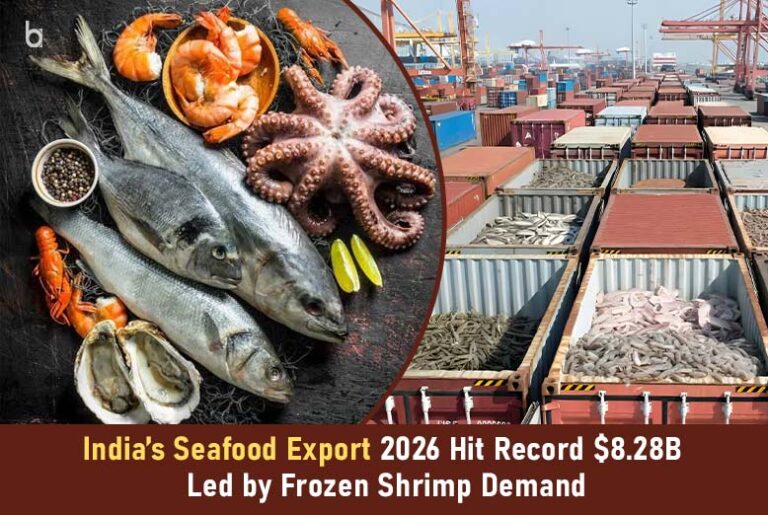
India achieved a historic milestone in the maritime sector as seafood exports reached an all-time high of $8.28 billion (₹72,326 crore) during the 2025-26 financial year.
This performance, as seen in the latest Marine Products Export Development Authority (MPEDA), is a huge increase from the previous year’s $7.38 billion, representing a robust double-digit increase in value.
Frozen shrimp remained the primary driver, accounting for roughly two-thirds of the total export earnings. This record was accomplished despite complex global hurdles, including logistical disruptions in West Asia and evolving trade barriers in major markets.
The Dominance of Frozen Shrimp in Global Markets
Frozen shrimp continues to be the crown jewel of India’s Seafood Export. In FY26, shrimp exports alone earned over $5 billion, maintaining their position as the most valued item in the export list. The demand was fueled by strong consumption in traditional markets like the USA and a sharp surge in orders from China.
The growth in shrimp exports is not just about volume but also about the shift toward higher-value products. Indian processors are increasingly focusing on “ready-to-cook” and “ready-to-eat” varieties, which command better prices globally. This move has helped maintain margins even when raw material costs fluctuated.
India Seafood Exports Amidst US Tariffs
The United States remains the largest destination for Indian seafood, but the relationship faced tests in 2026. The industry had to navigate India’s seafood Exports us tariffs, specifically anti-dumping duties and countervailing duties (CVD).
- Anti-Dumping Duties: These remain a recurring challenge, with rates being reviewed annually by the US Department of Commerce.
- Countervailing Duties: The imposition of preliminary CVD on Indian shrimp created initial friction, yet Indian exporters managed to sustain volumes through competitive pricing and high quality standards.
- Labor and Environmental Standards: The US also increased scrutiny on labor practices and the use of Turtle Excluder Devices (TEDs) in wild-caught shrimp.
To counter these pressures, the Marine Products Export Development Authority (MPEDA) worked closely with the government to ensure compliance and advocate for fair trade practices.
The Diversification Of India’s Seafood Exports
One of the most vital takeaways from the 2026 data is the success of india seafood exports diversification. For years, the industry was heavily reliant on the US and the European Union.
However, FY26 saw a deliberate and successful push into new territories.
- The China Surge: China emerged as a massive growth engine, with imports of Indian shrimp and fish increasing by over 20%. This helped offset the slower growth seen in some Western markets.
- Southeast Asian Expansion: Markets like Vietnam and Thailand increased their intake of Indian raw materials for further processing and re-export.
- Middle East Growth: Despite shipping disruptions in the Red Sea, exports to the Middle East remained steady, with a growing appetite for premium Indian seafood.
By expanding the “destination portfolio,” India has made its seafood industry more resilient to regional economic shocks or localized tariff changes.
Performance of Major Export Items in FY26
While shrimp led the way, other segments contributed to the record-breaking $8.28 billion total for India’s Seafood Exports.
| Export Item | Performance Note |
| Frozen Shrimp | Contributed ~67% of the total export value. |
| Frozen Fish | Second largest category; seen high demand in Southeast Asia. |
| Cuttlefish & Squid | Recorded steady growth in the European and Japanese markets. |
| Dried Items | Gaining traction in African and Asian markets for long-shelf-life needs. |
Overcoming Logistical and Geopolitical Hurdles
The path to $8.28 billion was not without obstacles. The industry faced significant headwinds due to the Red Sea crisis, which led to increased freight costs and longer transit times for shipments heading to Europe and the US East Coast.
Industry leaders noted that the “resilience of Indian exporters” was the defining factor of the year. By utilizing alternative shipping routes and negotiating better long-term contracts with carriers, the impact of these disruptions was minimized.
Furthermore, the government’s focus on improving port infrastructure under the Sagarmala project helped reduce turnaround times at major seafood hubs like Visakhapatnam and Kochi.
Insights from Industry Leader
Reflecting on the achievement, D.V. Swamy, Chairman of MPEDA, highlighted the importance of quality. He stated that the record figures are a testament to the “rigorous quality control measures” adopted by Indian farmers and processors. He also emphasized that the focus for the coming years will be on sustainability and traceability, which are becoming non-negotiable for global buyers.
Market analysts suggest that if the current trajectory continues, India could potentially reach a $10 billion seafood export target within the next three years.
Future Outlook for India’s Seafood Exports 2026 and Beyond
The success of India’s Seafood Exports 2026 sets a high benchmark for the future. The industry is now looking to move beyond “commodity exports” and establish Indian seafood brands in global retail chains.
The government has also proposed several incentives for deep-sea fishing vessels and modernized “aquaparks” to boost production capacity. As the world seeks reliable and diverse food sources, India is well-positioned to remain a top-tier supplier of high-quality marine products.
End Note
The record-breaking $8.28 billion performance of India’s Seafood Exports in FY26 is a landmark achievement for the nation’s blue economy. Through a combination of high demand for frozen shrimp, successful market diversification, and the ability to navigate complex US tariffs, the industry has proven its global competitiveness.
While challenges like high freight costs and international trade scrutiny remain, the focus on value-added products and new markets ensures that India will continue to be a dominant force in the global seafood trade for years to come.